
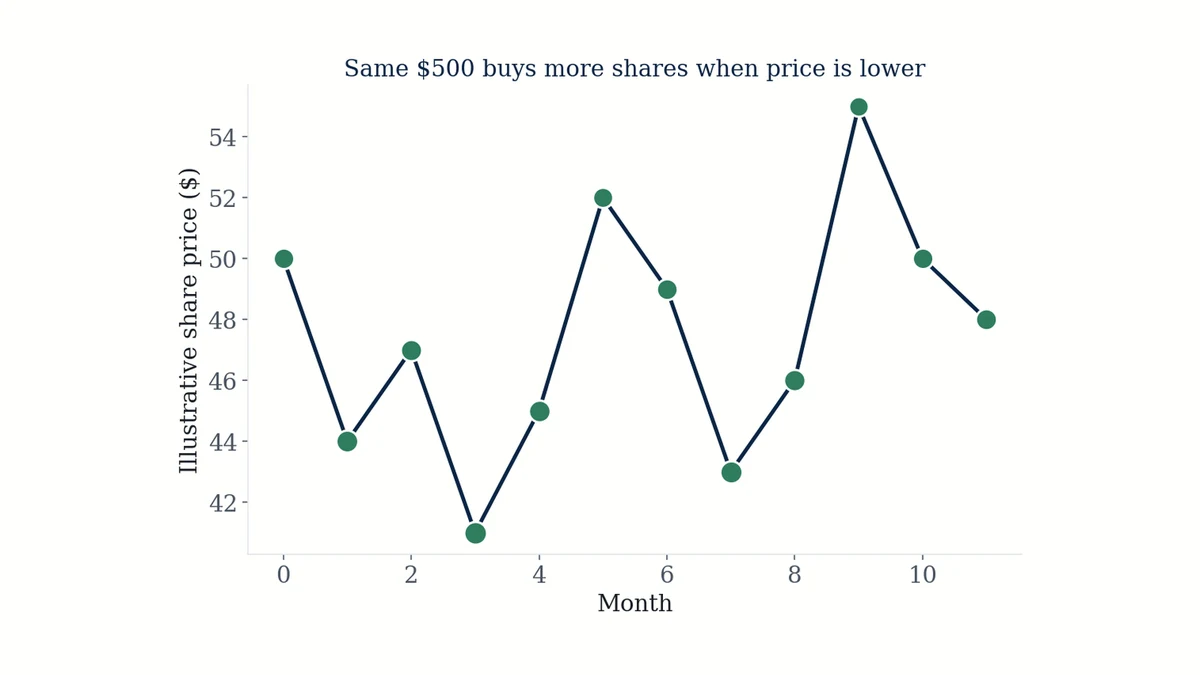
Dollar-cost averaging (DCA) means investing a fixed amount of money at regular intervals — say, $500 every month — regardless of whether prices are up or down that month, rather than investing a larger sum all at once. It's one of the most widely recommended investing habits, partly because it's genuinely useful and partly because, for most people with regular income, it's simply how investing happens by default: you invest as you earn, not all at once.
How dollar-cost averaging works, mechanically
With DCA, you invest the same dollar amount on a fixed schedule. When the fund's price is higher, that fixed amount buys fewer shares; when the price is lower, it buys more shares. Over time, this naturally results in an average purchase price that reflects a mix of high and low points, rather than the price on any single day. It doesn't guarantee a favorable price — it simply removes the need to guess when prices are "low" or "high" at any given moment, since you're buying on a schedule regardless.
A worked example
| Month | Share price | Amount invested | Shares purchased |
|---|---|---|---|
| 1 | $50 | $500 | 10.00 |
| 2 | $40 | $500 | 12.50 |
| 3 | $45 | $500 | 11.11 |
| 4 | $55 | $500 | 9.09 |
Total invested: $2,000. Total shares purchased: 42.70. Average price paid per share: $2,000 ÷ 42.70 ≈ $46.84 — notably lower than the simple average of the four prices ($47.50), because more shares were purchased during the lower-priced months. This is the mathematical mechanism behind DCA's "buy more when cheap, less when expensive" effect — it happens automatically, without requiring you to correctly identify which months were the cheap ones in advance.
Lump sum vs. DCA: what the historical data actually shows
For an investor deciding how to invest an existing sum of money they already have (as opposed to money they'll earn over time anyway), the question becomes: invest it all immediately, or spread it out over, say, twelve months? Historical backtests comparing these two approaches across many historical periods have generally found that investing a lump sum immediately outperformed spreading it out in a majority of periods studied — simply because broad stock markets have risen more often than they've fallen over most multi-month periods historically, so waiting to invest has usually meant missing out on further gains more often than avoiding a decline.
This is a statement about historical averages across many periods, not a guarantee about any specific future period — markets can and do decline, sometimes for extended periods, and past patterns aren't assured to repeat. It's presented here as a factual summary of historical backtesting results, not as a prediction.
Why DCA still has real value beyond pure math
Given the historical lump-sum edge described above, why is DCA still so widely recommended? Two main reasons. First, for the large majority of investors, the money being invested isn't an existing lump sum sitting in cash — it's income being earned over time, which naturally gets invested as it's received. In that very common case, DCA isn't really a choice against a lump-sum alternative at all; it's simply investing as you go, which is the only option available. Second, for someone who does have a lump sum, investing it all at once and then experiencing a downturn shortly afterward can be a genuinely difficult emotional experience that leads to panic-selling — locking in a real loss. Spreading the investment out, even if it's not mathematically optimal on average, can reduce that regret risk and make it more likely an investor actually stays invested through a downturn — see Market Volatility: What Index Investors Should Know for more on why staying invested through a decline tends to matter more than timing it.
How to implement DCA in practice
The easiest way to implement DCA consistently is through automatic recurring investments, set up directly through your brokerage (see How to Buy Your First Index Fund) — a fixed dollar amount, invested into your chosen fund, on a fixed schedule (often aligned with your pay schedule), without requiring a manual decision each time. This removes the temptation to skip a contribution during a downturn (often exactly when continuing to invest matters most) or to try to time individual purchases.
Common mistakes
- Stopping DCA during a market downturn. This is often when DCA's "buy more when prices are low" mechanism is providing the most benefit — pausing during a decline defeats the purpose.
- Treating DCA as a way to avoid all investment risk. It smooths purchase price; it does not eliminate market risk or guarantee a profit.
- Overcomplicating a simple habit. DCA doesn't require choosing an "optimal" interval — weekly, biweekly, and monthly schedules all achieve essentially the same underlying effect.
- Applying lump-sum-vs-DCA analysis paralysis to routine income investing. If the money is coming from regular income rather than an existing lump sum, this debate typically doesn't apply — just invest it as it comes in.
Frequently Asked Questions
Is dollar-cost averaging guaranteed to reduce my average cost?
It doesn't guarantee a lower average cost than a lump sum in every scenario — that depends on the specific price path over the period. It does guarantee your purchases are spread across a range of prices rather than concentrated at a single point in time.
How often should I dollar-cost average?
Common intervals include weekly, biweekly, or monthly, often aligned with pay schedules. The specific interval matters much less than doing it consistently.
Does DCA work for individual stocks the same way as index funds?
The mechanism works the same way mathematically, though DCA doesn't offset the added risk of holding a single company versus a diversified index fund — those are separate considerations.
Should I use DCA for an inheritance or bonus I just received?
This is a personal risk-tolerance decision — historical data generally favors investing immediately, but spreading a lump sum out over several months is a reasonable choice if it helps you stay invested with less anxiety. This isn't personalized financial advice.
Summary
Dollar-cost averaging invests a fixed amount at regular intervals, which naturally buys more shares when prices are low and fewer when prices are high, averaging your purchase price over time. For most people investing from regular income, it's the natural and appropriate approach by default. For someone deciding how to invest an existing lump sum, historical data has generally favored investing it immediately over spreading it out — but dollar-cost averaging a lump sum can meaningfully reduce the emotional risk and regret of poor timing, which has real value even if it's not strictly mathematically optimal on average.
This article is educational only and not personalized investment advice. See our full disclaimer.
Sources & References
Corrections & updates: No corrections logged since publication.