
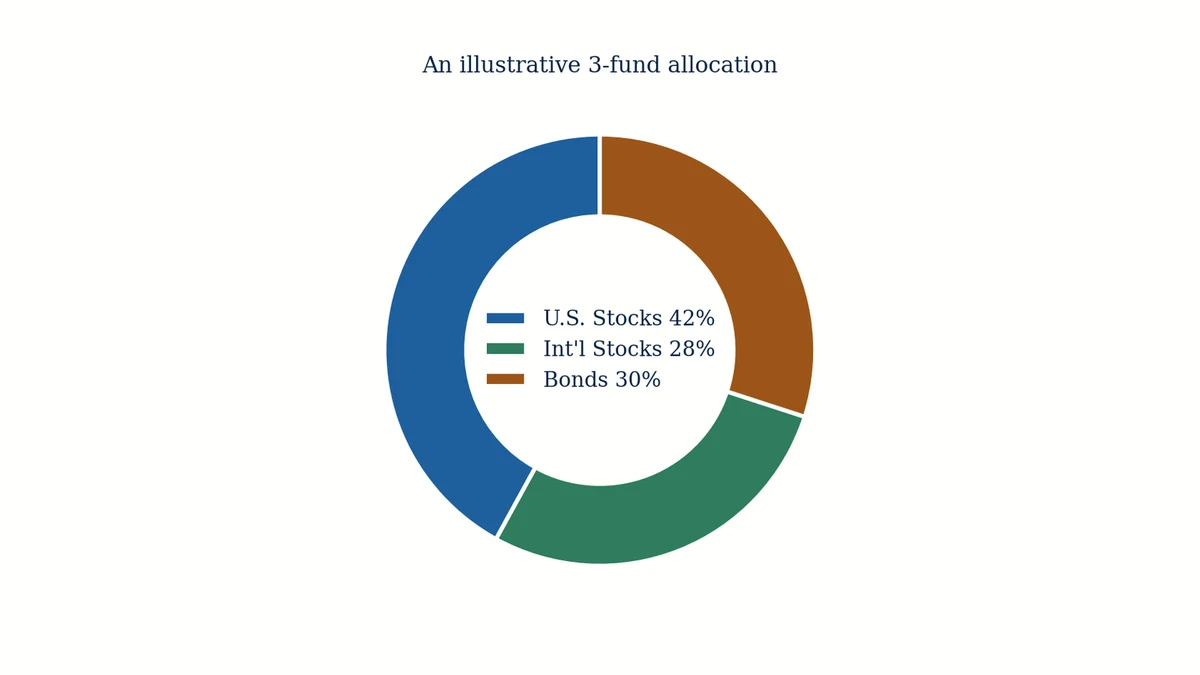
The three-fund portfolio is one of the most widely discussed index investing strategies, and its appeal is its simplicity: three broad index funds, covering U.S. stocks, international stocks, and bonds, combined in proportions matched to your goals. It's not the only reasonable way to build a portfolio, but it's a well-reasoned, well-documented starting framework worth understanding even if you eventually adapt it.
The three funds, and what each one contributes
| Fund category | What it contributes |
|---|---|
| Total U.S. stock market index fund | Broad exposure to U.S. companies of all sizes; typically the largest single piece for U.S.-based investors |
| Total international stock index fund | Exposure to companies outside the U.S., diversifying beyond a single country's economic cycle |
| Total bond market index fund | Fixed-income exposure, typically less volatile than stocks, reducing overall portfolio swings |
Together, these three categories span most of the investable public markets available to a typical individual investor through standard brokerage or retirement accounts, without requiring dozens of individual fund positions to achieve that breadth. If you want the fuller case for why each piece belongs in the mix, see International Index Funds Explained and Bond Index Funds Explained.
Why three funds instead of one, or ten
A single total U.S. market fund alone excludes international markets and bonds entirely — a deliberate choice for some investors, but not a comprehensive one. On the other end, building a portfolio from ten or more narrow funds (individual sector funds, individual country funds, and so on) usually adds complexity and rebalancing burden without a correspondingly large diversification benefit, since a broad fund in each of the three core categories already provides substantial diversification within that category. Three funds is presented as a reasonable middle point — broad enough to span major asset classes and geographies, simple enough to actually maintain consistently over decades.
Choosing your allocation percentages
The specific split between the three funds is a personal decision based primarily on time horizon and risk tolerance, not a fixed formula. A commonly used shorthand for the bond portion specifically is "age in bonds" (or variations like "age minus 10" or "age minus 20") — the idea that your bond allocation should roughly track your age, adjusted more aggressive or conservative depending on your risk tolerance. Applied to a three-fund portfolio, that bond percentage is simply split further between the stock categories. Some commonly discussed starting frameworks:
| Risk posture | U.S. stocks | International stocks | Bonds |
|---|---|---|---|
| Aggressive / long horizon | 54% | 36% | 10% |
| Moderate | 42% | 28% | 30% |
| Conservative / shorter horizon | 30% | 20% | 50% |
These are illustrative examples, not personalized recommendations — see Asset Allocation by Age for a more detailed discussion of how time horizon typically informs this decision, and consider consulting a financial professional for guidance specific to your situation.
A worked example: implementing a moderate allocation
Say you're implementing the "moderate" allocation above with a $12,000 initial investment: you'd invest roughly $5,040 (42%) into a total U.S. stock index fund, $3,360 (28%) into a total international stock index fund, and $3,600 (30%) into a total bond market index fund. Going forward, new monthly contributions would generally follow the same proportional split — for instance, a $600 monthly contribution would break down to roughly $252 U.S. stocks, $168 international stocks, and $180 bonds — though many investors simplify this in practice by directing contributions to whichever fund has drifted furthest below its target, which naturally helps maintain the target allocation over time with less manual calculation.
Keeping the portfolio on track over time
As the three funds grow at different rates, your actual allocation will drift from your original target — if stocks perform particularly well relative to bonds, for instance, your stock percentage will grow beyond its original target share. Periodically rebalancing back to your target allocation, typically checked once a year or when a fund drifts a meaningful amount (often cited around 5 percentage points) from its target, keeps the portfolio's risk level consistent with your original intention rather than silently becoming more aggressive or conservative than you intended. This is covered in full in Rebalancing Your Portfolio.
Common variations on the basic framework
The three-fund approach is a starting framework, not a rigid rule, and reasonable investors adapt it in different directions. Some simplify further to a single target-date fund or "all-in-one" fund that internally holds a similar three-part (or more granular) mix and automatically adjusts its allocation over time — trading a small amount of control and slightly higher fees for even less ongoing management; see 3-Fund Portfolio vs. Target-Date Fund for how that fee gap actually compares in practice. Others add a fourth or fifth fund — a dedicated real estate fund, a small-cap tilt, or a separate emerging markets fund — to express a more specific view. Neither direction is wrong; they represent different tradeoffs between simplicity, cost, and granular control.
Common mistakes
- Picking an allocation that doesn't match your actual risk tolerance. A stock-heavy allocation that leads to panic-selling during a downturn defeats its own purpose.
- Never rebalancing. An unmonitored portfolio can drift substantially from its original target allocation over years.
- Overlapping funds unintentionally. Adding funds outside the three-fund core without checking for overlap (see VOO vs. VTI vs. SPY for an example of this issue) can undermine the intended diversification.
- Changing the allocation reactively based on recent market moves. Adjusting a long-term target allocation in response to short-term performance tends to work against, not with, the strategy's design.
Frequently Asked Questions
Is the three-fund portfolio the 'best' portfolio strategy?
It's one well-reasoned, widely used approach, not the only correct one. Its main appeal is broad diversification with low complexity and cost, which suits many but not necessarily every investor's goals.
Can I build a three-fund portfolio inside a 401(k)?
Many 401(k) plans offer funds covering these three broad categories, though not always in the exact form (or at the exact cost) available in an IRA or taxable account — check your plan's specific fund menu.
How often should I check and rebalance a three-fund portfolio?
Many investors check roughly once a year, or when an allocation drifts a meaningful amount from target — frequent checking or rebalancing (e.g., monthly) is generally unnecessary and can add cost or complexity without clear benefit.
Do I need exactly three funds, or can I use two?
A two-fund version (e.g., combining U.S. and international into a single global stock fund, plus a bond fund) is a reasonable simplification some investors use; it's a variation on the same underlying logic.
Summary
A three-fund portfolio combines a total U.S. stock index fund, a total international stock index fund, and a total bond market index fund, in proportions based on your age, goals, and risk tolerance. Its appeal is genuine diversification across geography and asset class using just three funds, low ongoing complexity, and low cost. It's a starting framework, not a fixed rule — some investors reasonably simplify further or add categories, but understanding the three-fund logic clarifies what each piece is actually contributing to the whole.
This article is educational only and not personalized investment advice. See our full disclaimer.
Sources & References
Corrections & updates: No corrections logged since publication.