
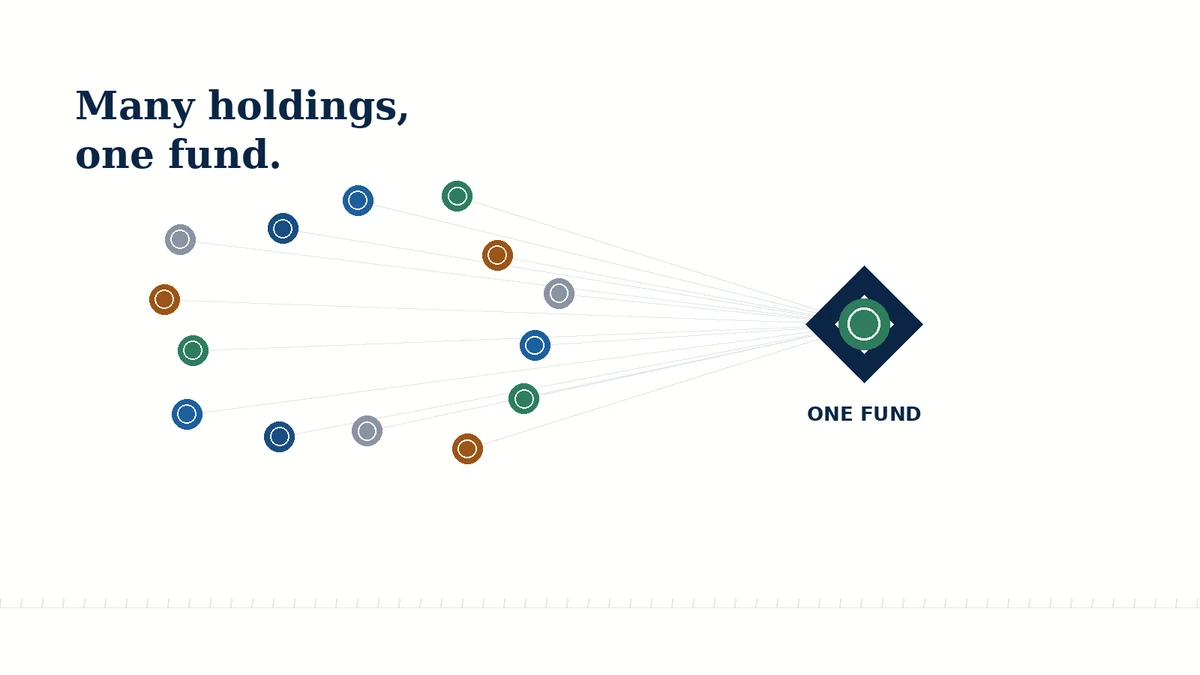
An index fund is a type of investment fund built to match, not beat, a specific segment of the market. Instead of a manager picking individual stocks they believe will outperform, an index fund simply holds the same securities — in roughly the same proportions — as a benchmark index like the S&P 500. That sounds almost too simple to matter. In practice, this simplicity is exactly why index funds now hold trillions of dollars in American retirement accounts, and why they're usually the first thing a financial educator recommends to a new investor.
This guide explains what an index fund actually is, how it's structured, why cost is the single most important variable to understand, and how to think about whether index investing fits your own goals.
How an index fund actually works
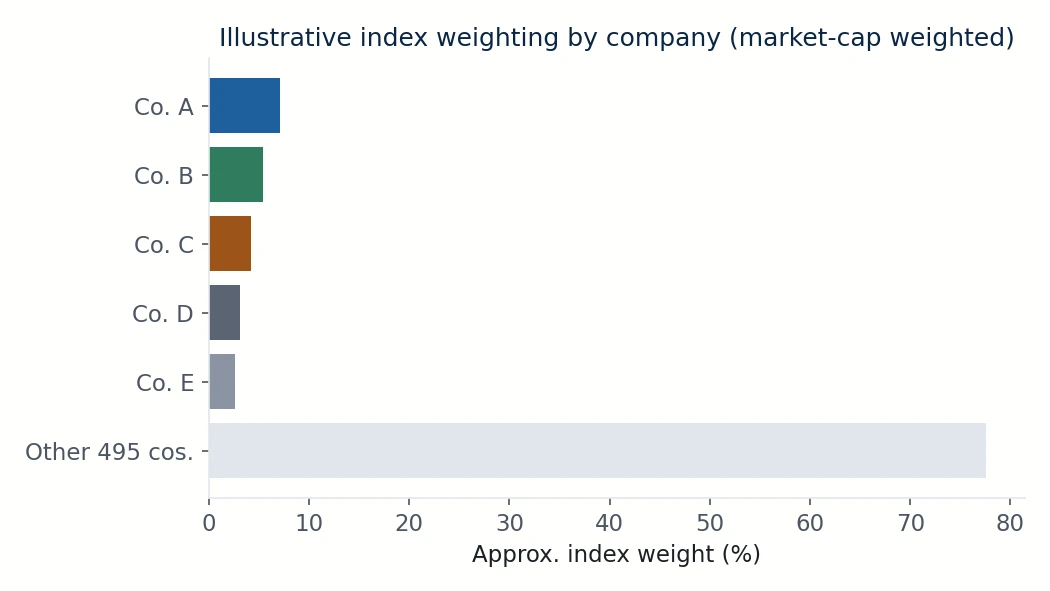
Every index has a defined set of rules: the S&P 500, for example, includes roughly 500 large U.S. companies selected by a committee based on market size, liquidity, and profitability criteria. An index fund tracking the S&P 500 buys shares of those same companies, in proportions that mirror each company's weight in the index — typically weighted by market capitalization, meaning larger companies make up a bigger slice of the fund.
To make that concrete: a single $500 purchase of an S&P 500 index fund doesn't buy stock in one company — it buys a proportional slice of roughly 500 companies at once, from the largest household names down to much smaller ones most investors have never heard of, in a single transaction. You're not picking a winner; you're buying a cross-section of the index as a whole.
When the index changes — a company is added or removed, or weights shift as prices move — the fund adjusts its holdings to match. This process is largely automated and rules-based, which is a big part of why index funds are cheap to run: there's no team of analysts deciding what to buy and sell.
Index funds vs. actively managed funds
An actively managed fund employs a manager or team who selects individual securities they believe will outperform a benchmark, and adjusts holdings based on research, forecasts, or market timing. This requires research staff, trading activity, and judgment calls — all of which cost money, reflected in a higher expense ratio.
The core argument for index investing isn't that active managers are incompetent. It's that, after fees, the median active fund has historically underperformed its benchmark over long periods, and predicting which active fund will beat its benchmark in advance is difficult even for professionals. Index funds sidestep that prediction problem entirely by not attempting to win — they aim to capture the market's return, minus a small fee.
| Feature | Index fund | Actively managed fund |
|---|---|---|
| Goal | Match a benchmark's return | Beat a benchmark's return |
| Holdings decided by | Index rules | Fund manager's judgment |
| Typical expense ratio | Often 0.03%–0.20% | Often 0.50%–1.50%+ |
| Turnover | Low | Often higher |
Exact fees vary by fund and change over time — always check a fund's current prospectus rather than relying on general figures like the ones above.
Why the expense ratio matters more than it seems to
An expense ratio is the annual fee a fund charges, expressed as a percentage of your investment. A 0.90% expense ratio sounds small next to a 0.03% one — a 0.87 percentage point gap. But that gap is charged every year, on your entire balance, and it compounds against you the same way returns compound for you.
We cover this in far more depth, with the full math, in Expense Ratios Explained.
What an index fund does not promise
An index fund will not protect you from a market downturn — if the index it tracks falls 20%, the fund falls roughly 20% too. It also won't outperform its benchmark; by design, it will very slightly underperform the benchmark, by roughly the amount of its expense ratio, because the benchmark itself has no costs.
Index funds also aren't automatically diversified across everything. An S&P 500 index fund only holds large U.S. companies — it has no exposure to small-cap stocks, international markets, or bonds. "Index fund" describes a structure, not a specific level of diversification; you still need to think about which index, or combination of indexes, matches your goals.
It's also worth being precise about a related, often-blurred point: index funds don't eliminate risk, they simply spread it across many companies instead of concentrating it in a few. If every company in an index declines together — as happens in a broad market downturn — diversification within that index provides no protection, because the risk being diversified away is company-specific risk, not market-wide risk. Reducing market-wide risk generally requires holding a different asset class, such as bonds, alongside stock index funds, which is a portfolio-construction question rather than a fund-selection one — see Asset Allocation by Age.
Pros and cons
- Typically low fees relative to active funds
- Broad, rules-based diversification within the tracked index
- Transparent holdings and predictable behavior
- No reliance on a manager's skill or judgment
- Will never outperform its benchmark
- Full exposure to that index's downturns
- Only diversified within the index it tracks, not beyond it
- Requires you to choose the right index(es) for your goals
Common mistakes new index investors make
- Assuming "index fund" means "safe." A stock index fund still carries full stock market risk.
- Chasing last year's best-performing index. Sector or thematic index funds that performed well recently often revert; past performance isn't a reliable predictor.
- Overlapping funds without realizing it. A total U.S. market fund and an S&P 500 fund already overlap heavily — holding both usually doesn't add real diversification.
- Ignoring the expense ratio because the difference "looks small." As shown above, small percentage gaps compound significantly.
- Panic-selling during downturns. Since an index fund mirrors the market, its value will fall in a downturn — the strategy depends on staying invested through that, not exiting.
A brief history: why index funds even exist
The first index mutual fund available to individual investors launched in 1976, built on academic research suggesting that most professional stock-pickers failed to consistently beat the market after accounting for their fees and trading costs. The idea was met with skepticism — critics called it "a formula for mediocrity," since deliberately not trying to beat the market seemed like giving up.
Over the following decades, a large and growing body of independent performance data comparing active fund returns to their benchmarks tended to support the original thesis: in most categories and most time periods, a majority of actively managed funds underperformed their benchmark index after fees. That track record — not marketing — is why index investing shifted from a contrarian idea to a mainstream default over roughly two generations. It's worth understanding this history because it explains why the low-cost, benchmark-tracking structure exists in the first place, rather than treating it as received wisdom.
A worked example: how two investors diverge over 20 years
Numbers make the fee argument concrete. Imagine two investors, each starting with $10,000 and adding $400 a month for 20 years. Both funds happen to deliver the same 8% gross annual return before fees — a simplifying assumption, since no one can predict actual future returns, but it isolates the effect of cost alone.
- Investor A uses a low-cost index fund charging a 0.05% expense ratio.
- Investor B uses an actively managed fund charging a 1.00% expense ratio.
After fees, Investor A effectively earns roughly 7.95% annually, while Investor B earns roughly 7.00% annually. That's less than a one-percentage-point gap per year — and yet, compounded over 20 years on a growing balance, it typically works out to a difference in the tens of thousands of dollars by the end of the period, with no difference whatsoever in the underlying market performance the two funds experienced. Neither investor "beat the market" or "lost to the market" in this example; the entire gap comes from cost. You can substitute your own numbers using our fee drag calculator or compound interest calculator to see how sensitive the outcome is to your specific contribution amount and time horizon.
This example deliberately assumes identical gross performance to isolate the fee effect. In reality, actively managed funds sometimes do outperform their benchmark before fees in a given year — the open question an investor has to weigh is whether that outperformance, which is unpredictable in advance, is likely enough and large enough to outweigh a persistently higher fee, year after year, for decades.
Who index investing tends to suit — and who it might not
Index investing tends to suit people who want a diversified, low-maintenance approach to long-term investing and who are comfortable accepting the market's return rather than trying to beat it. It also tends to suit people who value simplicity: a small number of broad index funds can form a complete portfolio without requiring ongoing stock-picking decisions.
It may be a poorer fit for someone who wants to actively research and select individual companies as a hobby or profession, who has strong, well-researched convictions about specific sectors or securities, or whose account is small enough and short-term enough that broad diversification matters less than a specific savings goal. None of these are wrong reasons to do something else — they're just different goals than the ones index investing is built to serve. The point isn't that index investing is universally correct, but that it's a reasonable, evidence-informed default for investors who haven't decided on a different approach for a specific reason.
How to get started
The practical steps are: open a brokerage or retirement account, choose a broadly diversified, low-cost index fund appropriate to your goals and time horizon, and set up regular contributions. We walk through this in full in How to Buy Your First Index Fund, and cover portfolio construction in Building a 3-Fund Portfolio.
Frequently Asked Questions
Are index funds only for stocks?
No. Index funds exist for bonds, international markets, real estate, and other asset classes — the same tracking structure applies to indexes covering any of those segments.
Can an index fund lose money?
Yes. An index fund's value moves with the index it tracks. If the underlying market declines, the fund's value declines too.
Is an index fund the same as an ETF?
Not necessarily. "Index fund" describes a strategy (tracking a benchmark); it can be structured as either a traditional mutual fund or an ETF. See our guide on index funds vs. ETFs vs. mutual funds.
What's a reasonable expense ratio for an index fund?
Many broad-market U.S. stock index funds charge between roughly 0.03% and 0.10%. Always check the fund's current prospectus, since fees can change.
Summary
An index fund holds the same securities as a market benchmark in order to match that benchmark's performance, rather than trying to beat it. Because there's no manager making active bets, index funds typically charge far lower fees than actively managed funds — and over long time horizons, that fee difference compounds into a meaningful gap in ending wealth. For most long-term investors, a low-cost, broadly diversified index fund is a reasonable default building block, though it isn't the only reasonable choice, and understanding why it works is more useful than following it as a rule of thumb.
This article is educational only and not personalized investment advice. See our full disclaimer.
Sources & References
- U.S. Securities and Exchange Commission — Mutual Funds and ETFs Investor Bulletin
- SEC EDGAR — Fund Prospectus Filings
- Federal Reserve Economic Data (FRED)
Corrections & updates: No corrections logged since publication.