
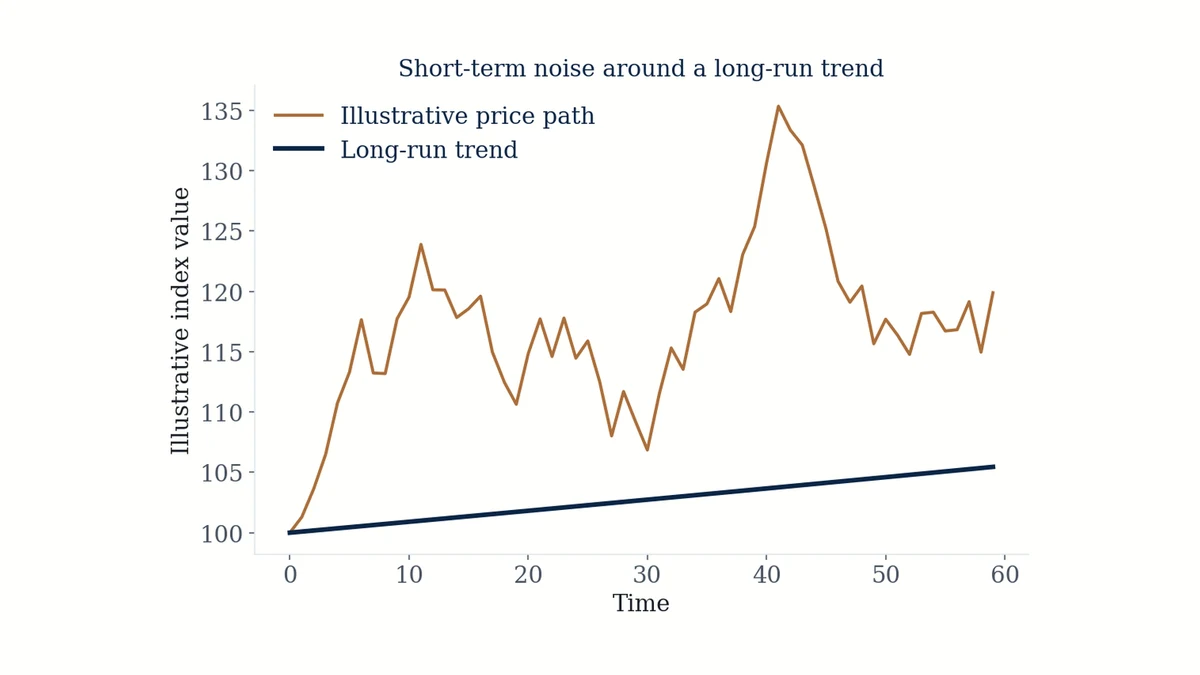
Every long-term stock investor will experience market downturns — this isn't a risk that careful fund selection can eliminate, because it's inherent to owning stocks at all. What actually determines how a downturn affects your outcome is less about which index fund you hold and more about how you respond when it happens. This guide covers the historical context and behavioral framework for thinking about volatility as a long-term index investor.
Volatility is a feature of stock investing, not a flaw in your fund choice
Because an index fund is designed to track its benchmark, it will decline when the benchmark declines — this is not evidence of a poorly chosen fund, a poorly performing manager, or anything correctable through different fund selection. The volatility is coming from the underlying stock market itself, which every diversified stock fund, index or active, is exposed to. Understanding this distinction matters because it clarifies that the appropriate response to a downturn is a behavioral and allocation question, not a "should I switch funds" question.
Historical context on downturns and recoveries
Historically, the U.S. stock market has experienced declines of 10% or more (sometimes called "corrections") with some regularity — multiple times per decade, on average, based on long-run historical data — as well as less frequent but deeper declines of 20% or more (sometimes called "bear markets"). In most historical instances, markets have eventually recovered to new highs and continued growing over a long enough subsequent period, though the length of time between a decline and a full recovery has varied significantly by episode — sometimes months, sometimes multiple years. This is a summary of historical patterns, not a guarantee about how any future decline will behave; past recoveries are not proof that a future decline will follow the same pattern or timeline.
Why time horizon changes how much volatility should concern you
An investor with a multi-decade time horizon before they need the money has historically had time to experience and recover from downturns without needing to sell at a loss — the money simply isn't needed during the decline. An investor who needs the money within the next few years has much less buffer, and a poorly timed decline right before a planned withdrawal can meaningfully affect their actual available funds — a dynamic covered in more detail in Sequence-of-Returns Risk. This is the central logic behind shifting toward a more conservative allocation as a specific financial goal approaches, covered in Asset Allocation by Age — it's a structural way of managing volatility risk in advance, rather than reacting to it after a decline has already begun.
What tends to make downturns feel worse than they are
A few common psychological patterns tend to amplify the discomfort of a downturn beyond its actual long-term significance: checking account balances frequently during a decline, which emphasizes short-term paper losses that may not reflect the eventual outcome; comparing your portfolio's performance to a specific recent high point rather than to your original investment or long-term trend; and consuming financial news coverage that tends to emphasize dramatic short-term narratives over historical base rates. None of these change the actual math of your portfolio — they change how the same numbers feel, which is exactly why behavioral discipline, not additional fund research, is usually the more relevant response during a downturn.
What a reasonable response to a downturn actually looks like
For a long-term investor with an allocation already matched to their actual time horizon and risk tolerance (rather than one that was too aggressive to begin with), a reasonable response to a downturn is generally to continue regular contributions as scheduled — which, via dollar-cost averaging, means purchasing shares at relatively lower prices during the decline — and to avoid making reactive allocation changes based on the downturn itself. This is a different recommendation than "do nothing ever": periodic rebalancing (see Rebalancing Your Portfolio) remains appropriate, and continuing to reassess whether your overall allocation still matches your goals is reasonable — the distinction is between planned, disciplined portfolio maintenance and reactive decisions driven specifically by short-term fear during a decline.
When it's reasonable to reduce risk, and when it isn't
It's entirely reasonable to reduce your stock allocation in response to a genuine change in your time horizon or circumstances — approaching a planned withdrawal, a change in job security, or a reassessment of your actual risk tolerance based on how a previous downturn genuinely felt to live through. It's a different matter to reduce risk purely as a reaction to a decline already having happened, with the intention of "waiting it out in cash" and re-entering later — this requires being right about both the exit timing and the re-entry timing, a difficult combination to get right consistently, and mistiming either one can meaningfully hurt long-term results compared to simply remaining invested throughout.
Common mistakes
- Selling during a decline out of fear, then buying back in after prices have already recovered. This effectively locks in a loss and misses part of the recovery.
- Checking account balances excessively during a downturn. This tends to amplify anxiety without providing actionable new information.
- Assuming a downturn means your fund or strategy was a mistake. Volatility is inherent to stock investing broadly, not a signal about fund quality.
- Setting an allocation too aggressive for your actual risk tolerance in calm markets. The best time to set an appropriate allocation is before a downturn, when it's easier to think clearly about your true risk tolerance.
Frequently Asked Questions
How often do stock market corrections happen?
Historically, declines of 10% or more have occurred with some regularity — multiple times per decade on average, based on long-run historical data — though frequency varies by period and cannot be predicted for any specific future timeframe.
Should I move to cash during a downturn?
Moving to cash requires correctly timing both the exit and a subsequent re-entry, which is difficult to do consistently — for a long-term investor with an appropriately matched allocation, remaining invested has historically tended to outperform attempts to time downturns, though this isn't a guarantee about any specific future period.
Does diversification eliminate volatility?
Diversification reduces company-specific risk but doesn't eliminate broad market-wide volatility — if the overall market declines, a diversified index fund will decline too, just without the added risk of concentration in any single company.
How do I know if my allocation is too aggressive?
A common signal is finding yourself seriously considering selling during a decline out of fear — if a paper loss feels intolerable, it may indicate your allocation carries more risk than matches your actual tolerance, worth reassessing during a calm period rather than during a downturn itself.
Summary
Market downturns are a normal, recurring feature of investing in stocks, not a sign that something has gone wrong — historically, declines of 10% or more have occurred with some regularity, and markets have, over sufficiently long periods, recovered and gone on to reach new highs, though any specific future decline's depth and recovery time cannot be predicted in advance. An index fund's value will decline along with its benchmark during a downturn by design; the strategy's success depends on remaining invested through that decline, not avoiding it.
This article is educational only and not personalized investment advice. See our full disclaimer.
Sources & References
Corrections & updates: No corrections logged since publication.