
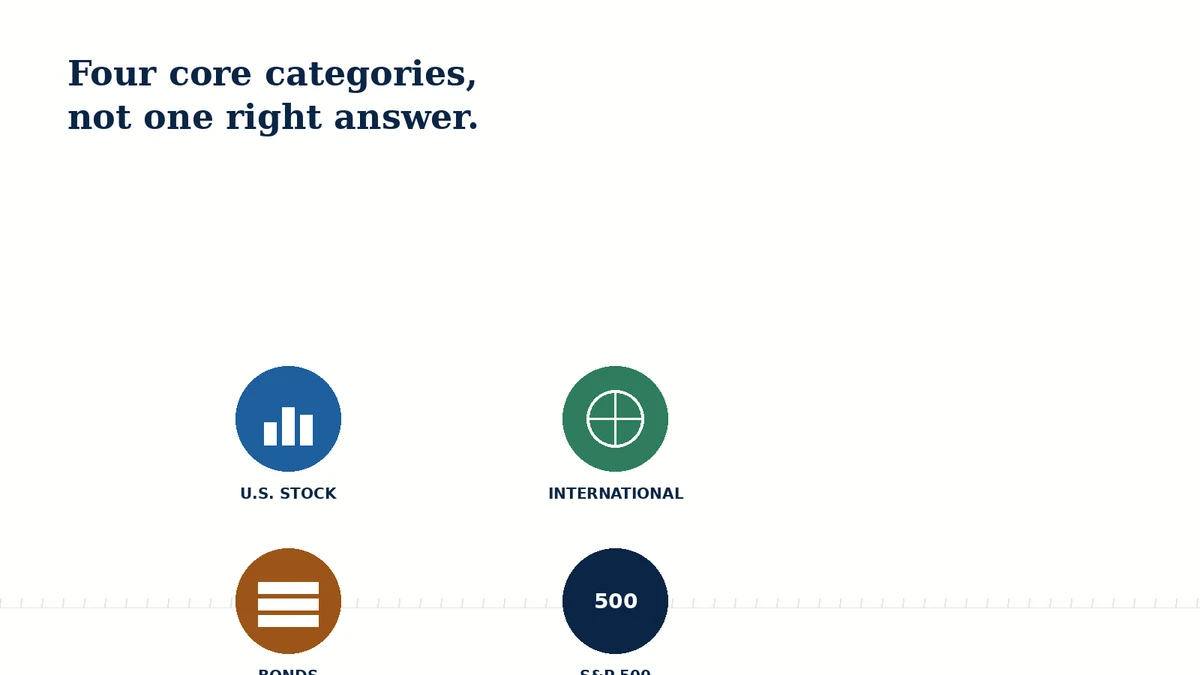
Lists of "best funds" go stale quickly and can read as endorsements even when they're not intended that way. This guide takes a different approach: instead of naming a fixed list of tickers, it explains the categories of index funds most commonly recommended for beginners, why each category serves the purpose it does, and exactly how to evaluate a specific fund yourself — a skill that stays useful long after any specific ticker recommendation goes out of date.
Why this isn't a simple ranked list
A specific "top 5 index funds" list has a short shelf life: expense ratios change, new lower-cost funds launch, and a list optimized for search traffic risks conflating "well known" with "best for you." More importantly, presenting a ranked list without explaining the reasoning teaches you nothing you can reuse the next time you need to evaluate a fund — including funds that don't exist yet. This guide focuses instead on the categories that matter and the evaluation process, which stays useful indefinitely.
Category 1: Total U.S. stock market funds
A total U.S. stock market index fund holds companies across the full range of market capitalization — large, mid, and small-cap — offering the broadest single-fund exposure to U.S. equities available. This is one of the most commonly recommended single starting holdings for a beginner specifically because it doesn't require choosing between large and small companies; it holds both, weighted by actual market value. Multiple major low-cost providers offer a fund in this category; comparing their current expense ratios directly is a reasonable first step.
Category 2: S&P 500 funds
An S&P 500 index fund is a close cousin to a total market fund, covering large-cap U.S. companies specifically. As explained in S&P 500 Index Funds Explained, because large-caps dominate total market weighting anyway, the practical difference between an S&P 500 fund and a total market fund is often smaller than it might seem — the main distinction is whether small and mid-cap companies are included at all. Either is a reasonable starting choice; they're not competing recommendations so much as two closely related options.
Category 3: Total international stock funds
A total international stock index fund adds exposure to companies outside the United States — developed markets (like Japan, the UK, and much of Europe) and, depending on the specific fund, emerging markets as well. U.S.-only portfolios have historically been common among American investors, sometimes for practical reasons (home-market familiarity) and sometimes as a deliberate choice; adding international exposure is a genuine diversification decision, not a strictly necessary one, and reasonable long-term investors land on different answers here.
Category 4: Bond index funds
A total bond market index fund adds fixed-income exposure, which has historically tended to be less volatile than stocks and can reduce a portfolio's overall swings, at the cost of typically lower long-run expected returns than stocks. How much bond exposure (if any) makes sense depends heavily on time horizon and risk tolerance — a 25-year-old investing for a retirement decades away typically has a different reasonable bond allocation than someone five years from retirement. This is covered in depth in Asset Allocation by Age.
How to actually evaluate a specific fund
Whichever category you're choosing within, apply the same evaluation checklist to any specific fund before buying:
- Confirm the exact index it tracks by reading the fund's stated benchmark in its prospectus, not just its name.
- Compare its current expense ratio against other funds tracking the same or a very similar index.
- Check its tracking accuracy — how closely its historical returns have matched its benchmark, beyond what the expense ratio alone explains.
- Check fund size and trading volume (for ETFs) — very small or thinly traded funds carry additional risks, including potential fund closure.
- Confirm it's available in your specific account — not every fund is offered through every 401(k) plan or brokerage.
This process takes a few minutes per fund using publicly available fact sheets, and it's a skill that remains useful for the rest of your investing life, unlike memorizing a specific ticker.
A reasonable starting combination for many beginners
As an illustrative example — not a personalized recommendation — a commonly discussed simple starting combination pairs a total U.S. stock market fund with a total international stock fund and a total bond market fund, in proportions based on age and risk tolerance. This is often called a "three-fund portfolio," covered in full in Building a 3-Fund Portfolio. Some beginners start even simpler, with a single total market or S&P 500 fund, and add other categories later as their balance and understanding grow — also a reasonable approach.
What separates a genuinely low-cost fund from a mediocre one
Within any given category, providers compete mainly on expense ratio and tracking accuracy, and the spread between the cheapest and most expensive options tracking a similar index can be surprisingly wide. It's worth looking at this concretely rather than abstractly:
| Category | Typical low end | Typical high end | Why the gap exists |
|---|---|---|---|
| Total U.S. stock market | ~0.03% | ~0.20%+ | Older or smaller fund families price higher than the largest low-cost providers |
| S&P 500 | ~0.03% | ~0.15%+ | Legacy funds and certain trust structures often carry higher fees than newer entrants |
| Total international stock | ~0.05% | ~0.30%+ | International index construction and currency handling add some cost variation |
| Total bond market | ~0.03% | ~0.20%+ | Similar dynamic to U.S. stock funds — provider scale matters |
The takeaway isn't a specific number to memorize — it's that "index fund" alone doesn't guarantee a low fee. Two funds tracking nearly the same benchmark can differ by several multiples in cost, and that gap compounds exactly as described in Expense Ratios Explained. A five-minute comparison before buying is the habit that actually matters here, more than any specific ticker.
A short decision framework for a first purchase
If you're choosing a first fund and feeling stuck between reasonable options — and want a refresher on what an index fund actually is before deciding, see What Is an Index Fund? — a simple sequence: (1) decide whether you want U.S.-only or U.S.-plus-international exposure — both are defensible; (2) within that choice, compare the two or three lowest-cost funds available through your specific brokerage or 401(k), since availability varies by provider; (3) confirm each candidate's tracking accuracy over at least a several-year period, not just its fee; (4) pick the lowest-cost option that clears that tracking-accuracy bar, and move on. This process takes longer to describe than to actually do — the goal is a "good enough, verified" choice made once, not an optimal choice arrived at through prolonged research paralysis that delays actually starting.
Frequently Asked Questions
What's the single best index fund for a total beginner?
There's no universally 'best' fund — it depends on account type, goals, and time horizon. A broad, low-cost total U.S. market or S&P 500 fund is a commonly cited reasonable starting point for many beginners, but this isn't personalized advice.
Should I pick funds based on past performance?
Past performance doesn't reliably predict future returns, and it's not a sound basis for choosing between funds tracking similar indexes. Expense ratio, tracking accuracy, and fit with your goals are more durable evaluation criteria.
How many index funds do I need to be diversified?
It's possible to be broadly diversified with a single total-market fund, since it already holds thousands of companies. More funds (international, bonds) add diversification across additional asset classes and geographies, not necessarily 'more' diversification in an unqualified sense.
Do I need to pick different funds for a 401(k) vs. an IRA?
Not necessarily the same specific fund, since availability differs by provider, but the same category logic (broad, low-cost, matching your goals) applies across any account type.
Summary
For most beginners, the starting point is a broad, low-cost fund covering either the total U.S. stock market or the S&P 500, sometimes paired with an international stock fund and a bond fund as the portfolio matures. Rather than chasing a specific "best" ticker, the more durable skill is knowing how to evaluate any candidate fund on index scope, expense ratio, tracking accuracy, and fund size — criteria that remain useful regardless of which specific funds exist or how their fees change over time.
This article is educational only and not personalized investment advice. See our full disclaimer.
Sources & References
Corrections & updates: No corrections logged since publication.