
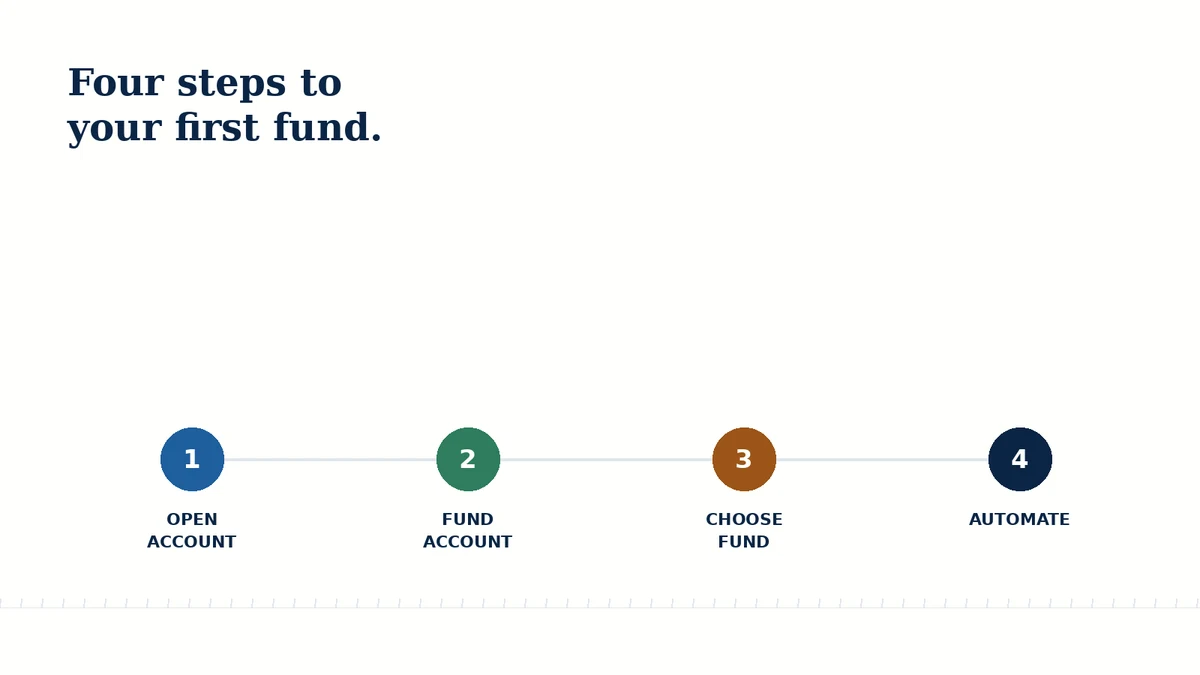
The mechanics of buying an index fund take about twenty minutes once you know the steps — the part that actually takes thought is choosing the right account type and fund before you get there. This walkthrough covers both: the decisions to make first, and the exact process of opening an account and placing your first order.
Step 1: Decide what the money is for, and when you'll need it
Before choosing an account or a fund, clarify the money's purpose and time horizon, because this determines both account type and appropriate risk level. Retirement savings you won't touch for decades can typically tolerate more stock market volatility than a house down payment you need in two years. Money needed within roughly the next three to five years is generally not well suited to being invested in stock index funds at all, since a market downturn right before you need the money could force you to sell at a loss — a high-yield savings account or short-term bond fund is usually a better fit for near-term goals.
Step 2: Choose the right account type
| Account type | Best for | Tax treatment |
|---|---|---|
| 401(k) / employer plan | Retirement, especially if there's an employer match | Pre-tax or Roth, depending on plan; grows tax-deferred or tax-free |
| Traditional IRA | Retirement, outside or in addition to a 401(k) | Often tax-deductible now, taxed on withdrawal |
| Roth IRA | Retirement, especially for younger investors or lower current tax brackets | After-tax now, tax-free qualified withdrawals |
| Taxable brokerage account | Any goal, no contribution limits or withdrawal restrictions | Capital gains and dividends taxed in the year realized |
A common, reasonable order of priority: contribute enough to a 401(k) to capture any full employer match first (it's an immediate, guaranteed return on that portion), then consider maxing out an IRA, then return to the 401(k) or use a taxable account for additional savings. This isn't universal advice for every situation, but it's a common starting framework. We cover the Roth vs. Traditional decision in depth in Traditional vs. Roth IRA for Index Investors.
As a concrete illustration of why the employer match ordering matters: if your employer matches 50% of contributions up to 6% of your salary, contributing that 6% earns an immediate, risk-free 50% return on that portion before the money is even invested in the market — no index fund, however well chosen, can reliably match that. Skipping a full match to prioritize an IRA instead usually means leaving free money on the table, which is why it's typically placed first in the funding order despite an IRA sometimes offering a broader fund selection.
Step 3: Open the account
If you're using a 401(k), this step is usually handled through your employer's HR or benefits portal — you're enrolling in an existing plan, not opening a brand-new account from scratch. For an IRA or taxable brokerage account, you'll apply directly with a brokerage firm, typically requiring your Social Security number, employment information, and a way to fund the account (a linked bank account is standard). Most major low-cost brokerages let you complete this online in about ten to fifteen minutes, with no cost to open the account itself. See Best Brokerage Accounts for Index Investing for a comparison of options.
Step 4: Fund the account
Once the account is open, you'll transfer money into it — typically via a linked bank account (ACH transfer), which usually takes one to three business days to clear before the funds are available to invest. Some brokerages allow you to place a fund order at the same time as the transfer, which will execute once the funds settle; others require the cash to be available first. Check your specific provider's process.
Step 5: Choose your fund
For a first index fund, the most commonly recommended starting point is a broad, diversified fund — a total U.S. stock market index fund or an S&P 500 index fund are both common choices, sometimes paired with a total international stock index fund and a bond index fund as the portfolio grows. We cover this decision in detail in Building a 3-Fund Portfolio and Best Index Funds for Beginners. The key things to check before selecting a specific fund: its expense ratio, what index it tracks, and (for ETFs) its typical daily trading volume.
Step 6: Place the order
In your brokerage's trading interface, search for the fund by its ticker symbol (e.g., a specific ETF or mutual fund ticker), enter the dollar amount or number of shares you want to buy, and choose an order type. For a long-term, buy-and-hold ETF purchase, a limit order (specifying the maximum price you're willing to pay) is generally a reasonable default over a market order, especially for less heavily traded funds, since it protects you from an unexpectedly wide bid-ask spread. For a traditional index mutual fund, you'll typically just specify a dollar amount, and the order executes at that day's closing price (NAV).
Step 7: Set up automatic recurring contributions
Once your first purchase is complete, most brokerages let you schedule automatic recurring investments — for example, a fixed dollar amount transferred and invested every payday or every month. This is what actually implements dollar-cost averaging (see Dollar-Cost Averaging Explained) and removes the need to make a fresh decision every month, which tends to improve long-term consistency more than any single well-timed purchase would.
Order types explained a little further
Since order type is one of the more confusing steps for first-time buyers, it's worth spelling out the two most common options in more detail:
- Market order: executes immediately at the best currently available price. Simple and fast, but on a thinly traded fund, the price you actually get can differ meaningfully from the price you saw a moment earlier, especially during volatile market conditions.
- Limit order: executes only at your specified price or better. You set a maximum price you're willing to pay (for a buy order); if the market never reaches that price, the order simply doesn't execute. This adds a small amount of friction and requires checking back, but it protects you from paying an unexpectedly wide spread.
For a well-established, heavily traded broad-market ETF (or a traditional index mutual fund, which doesn't have this issue at all since it's priced once daily), the practical difference between order types is usually small. For less liquid or niche funds, it can matter more. When in doubt, a limit order set close to the current quoted price is a reasonable default that costs little in convenience.
A realistic first-month walkthrough
To make the process concrete: say you open a Roth IRA on a Monday, initiate a $500 transfer from your checking account the same day, and the funds clear by Wednesday. On Wednesday, you place a limit order for a total U.S. stock market index ETF, set a few cents above the current quoted price to ensure the order fills without significant delay, and it executes that afternoon. You then set up an automatic $200 monthly contribution scheduled for the first business day of each month going forward, invested in the same fund. From that point, the account largely runs itself: money moves automatically, buys the same fund automatically, and the main remaining task is an annual check-in — confirming the fund still matches your goals, checking whether your target allocation has drifted (see Rebalancing Your Portfolio), and confirming you're contributing within that year's IRS limits.
This is a deliberately simple example — a single-fund portfolio in a single account. Many investors eventually add a second or third fund for diversification, or additional accounts (a 401(k) alongside an IRA, for instance), but the underlying mechanics of "fund the account, place the order, automate the recurring contribution" remain the same regardless of how many accounts or funds you're eventually managing.
Common mistakes first-time buyers make
- Leaving cash uninvested for weeks after funding the account. Money sitting as cash in a brokerage account earns little to nothing until it's actually invested.
- Buying a fund without checking what it actually tracks. Similar tickers and names can represent very different underlying exposures.
- Using a market order on a thinly traded fund. This can result in paying a wider spread than necessary; a limit order avoids this.
- Trying to time the first purchase perfectly. Waiting for a "better entry point" indefinitely often costs more in missed time in the market than any single day's price movement would.
- Overlooking account contribution limits. IRAs and 401(k)s have annual IRS contribution limits that change periodically — verify the current limit on IRS.gov before contributing.
Frequently Asked Questions
How much money do I need to buy my first index fund?
For many ETFs, you can start with the price of a single share, or less if your broker supports fractional shares — often as little as $1–$25. Traditional mutual funds sometimes require a minimum initial investment, commonly in the $1,000–$3,000 range, though this varies by provider.
Should I invest a lump sum or spread it out over time?
Both are reasonable; investing a lump sum immediately has, on average, outperformed spreading it out in most historical periods, simply because markets rise more often than they fall — but dollar-cost averaging can reduce the emotional difficulty and regret risk of a poorly timed lump sum. See our full comparison in Dollar-Cost Averaging Explained.
Do I need a financial advisor to buy an index fund?
No. The process is designed to be accessible directly through a brokerage's website or app without professional assistance, though an advisor can be useful for broader financial planning questions.
What happens if I need the money back after investing?
You can generally sell fund shares and withdraw the proceeds, though retirement accounts (401(k), IRA) have rules and potential penalties for early withdrawal before a certain age — check your specific account type's rules first.
Summary
Buying your first index fund means choosing the right account type for your goal (retirement account vs. taxable brokerage), opening that account with a low-cost provider, selecting a broadly diversified, low-fee index fund appropriate to your time horizon, and placing an order — ideally followed by setting up automatic recurring contributions so the decision doesn't need to be repeated every month. None of the individual steps are complicated; the value is in doing them in the right order and understanding what each choice actually means.
This article is educational only and not personalized investment advice. See our full disclaimer.
Sources & References
Corrections & updates: No corrections logged since publication.