
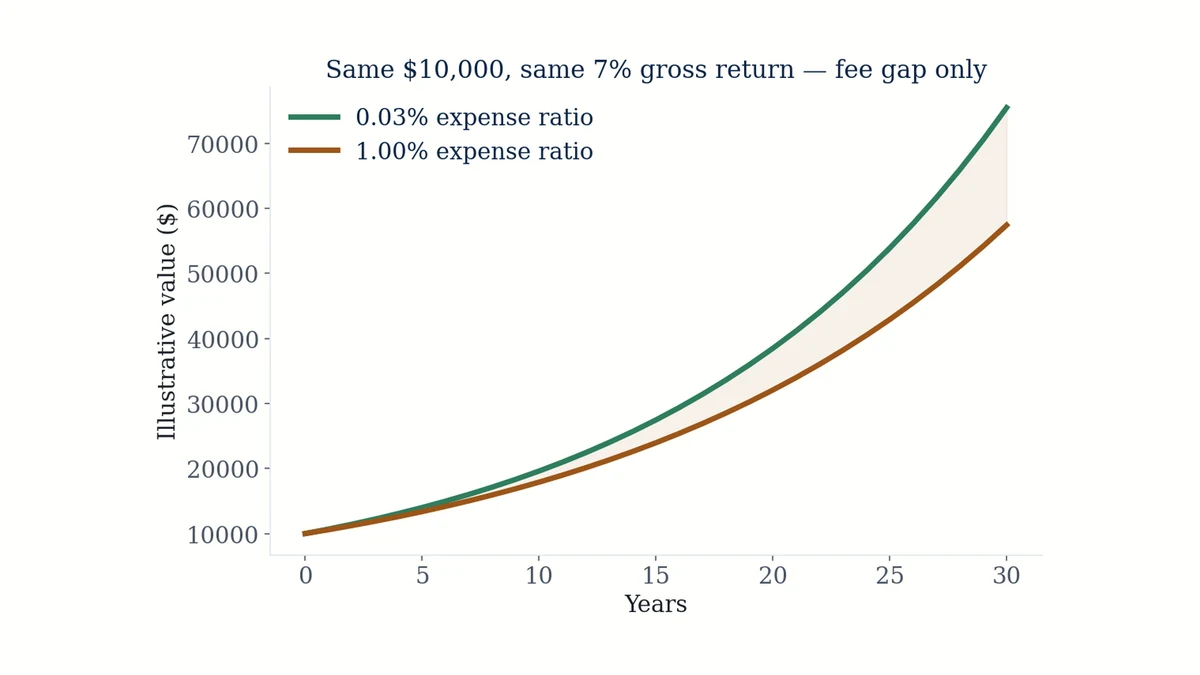
An expense ratio is the annual fee a fund charges its investors, expressed as a percentage of assets, to cover the fund's operating costs — management, administration, and other overhead. It's automatically deducted from the fund's returns; you never see a separate bill. That invisibility is exactly why it's easy to underestimate: a 0.75% expense ratio doesn't feel like "a fee," but over decades it behaves like one of the largest costs in an investor's entire financial life.
How an expense ratio is actually charged
An expense ratio is deducted continuously from the fund's assets, not billed to you as a separate invoice. If a fund has a 0.20% expense ratio, that roughly translates to the fund's daily performance being reduced by a small daily fraction of that 0.20%, applied to the fund's total assets under management. This is already baked into the fund's published returns and share price — a fund's performance figures are typically reported net of the expense ratio, meaning the fee has already been subtracted by the time you see the return.
This automatic, invisible deduction is precisely why expense ratios are easy to underweight in an investor's mental math compared to, say, a brokerage commission you actively pay and notice. There's no moment where you feel the cost — it simply reduces your balance's growth, year after year, without a transaction to point to.
Why a small percentage gap becomes a large dollar gap
The mechanism is compounding, working in reverse. Normal investment growth compounds because each year's gain is calculated on an already-larger balance than the year before. A fee works the same way: each year, the expense ratio is charged against a larger and larger balance (assuming the investment is growing and you're adding to it), so the dollar cost of the same percentage fee grows every year, even though the percentage itself never changes.
| Expense ratio | Approx. ending value | Approx. gap vs. 0.03% fund |
|---|---|---|
| 0.03% | ≈ $565,600 | — |
| 0.20% | ≈ $545,600 | ≈ $20,000 |
| 0.50% | ≈ $512,400 | ≈ $53,200 |
| 1.00% | ≈ $462,000 | ≈ $103,600 |
These figures are illustrative, using rounded, simplified assumptions — actual results depend on your specific contribution schedule and the market's actual (unpredictable) returns. You can run your own numbers with our fee drag calculator. The pattern that matters is directional: the gap between fee levels doesn't grow in a straight line, it accelerates, because the fee is compounding against an ever-larger balance in the same way returns are compounding for you.
What a reasonable expense ratio looks like today
Expense ratios vary widely by fund type and category, and change over time as providers compete on price, so always check a fund's current prospectus rather than relying on general benchmarks. As a rough frame of reference as of recent years: many broad U.S. stock market index funds from major low-cost providers charge in the range of roughly 0.03% to 0.10%; broad bond index funds are often similarly low; actively managed stock mutual funds have often charged somewhere in the range of 0.50% to 1.00% or more, though this varies significantly; and niche, thematic, or leveraged ETFs can charge notably more than broad index funds. These are general patterns, not fixed rules — some active funds charge less, some index funds charge more, particularly outside the largest, most competitive fund categories. For a direct look at how this plays out between three specific, widely held funds, see VOO vs. VTI vs. SPY.
Expense ratio vs. other fund costs
The expense ratio isn't necessarily the only cost of owning a fund, though for a typical broad-market index ETF or mutual fund, it's usually the dominant one. Other potential costs include:
- Bid-ask spread (ETFs only) — the small gap between buying and selling price at any moment, usually negligible for large, liquid funds.
- Brokerage commissions — largely eliminated by most major brokerages for online stock and ETF trades today, though it's worth confirming with your specific provider.
- Loads — a sales charge some (mostly older-style or advisor-sold) mutual funds charge when you buy or sell shares; broad low-cost index funds typically don't charge these, but it's worth checking a specific fund's prospectus.
- Tax costs — not a fund fee per se, but capital gains distributions can create a tax drag in taxable accounts, covered in Tax-Efficient Index Fund Investing.
How to find a fund's actual expense ratio
A fund's current expense ratio is published in its prospectus and fact sheet, typically available directly from the fund issuer's website (Vanguard, Fidelity, Schwab, iShares, and others all publish this for every fund they offer), and is also disclosed by most brokerages directly on the fund's trading page before you buy — see How to Buy Your First Index Fund for where this fits into the actual purchase process. It's worth checking this figure directly rather than relying on a older article, a forum post, or general knowledge — expense ratios do change over time, usually downward as the industry has become more price-competitive, but not always.
Why expense ratios have fallen so much over time
Index fund expense ratios today are, for many broad-market categories, a small fraction of what they were a few decades ago, driven largely by direct price competition between major providers rather than any change in what running an index fund actually costs to operate. As more investors began comparing fees directly — helped by exactly the kind of transparent fee disclosure required by SEC regulation — providers found that competing on price for the same underlying index exposure was often more effective than competing on marketing. This dynamic has generally continued, though it isn't guaranteed to continue indefinitely, and it's part of why re-checking a fund's current fee periodically (rather than assuming it's still whatever it was when you first researched it) remains a reasonable habit.
A word on "cheap" vs. "cheapest"
It's worth resisting the temptation to treat expense ratio as the single deciding factor to the exclusion of everything else. Two funds tracking the same index at 0.03% and 0.04% are, for practical purposes, close enough that the difference is unlikely to meaningfully change your outcome — the bigger question in that scenario is usually which fund has better long-run tracking accuracy, higher trading volume, or better fits your specific account (a mutual fund your 401(k) actually offers, for instance, versus a marginally cheaper ETF it doesn't). Expense ratio is a strong, easy-to-compare signal, but it's a tool for avoiding unnecessarily expensive options, not a tiebreaker between two funds that are both already inexpensive.
Pros and cons of prioritizing low expense ratios
- Cost is one of the few variables you can control directly; future returns aren't
- Fee differences compound in a predictable, mathematically certain direction
- Low-cost, broad index funds are widely available with strong track records of matching their benchmark
- Choosing the wrong index for your goals, even at a low fee, doesn't serve you well
- An extremely low fee on a poorly diversified or overly narrow fund isn't automatically a good choice
- Fee alone doesn't guarantee good tracking accuracy — check tracking error too
Common mistakes
- Assuming all index funds tracking the same benchmark cost the same. They often don't — compare directly.
- Ignoring a fee difference because it "looks small." As shown above, the dollar impact compounds well beyond what the percentage gap suggests.
- Chasing the single lowest fee across unrelated fund categories. A slightly higher fee on the right fund for your goal beats the lowest fee on the wrong one.
- Not rechecking fees periodically. Funds occasionally change their expense ratio; a fund that was competitively priced when you bought it may not always stay that way.
Frequently Asked Questions
Do I pay the expense ratio directly out of pocket?
No. It's deducted automatically from the fund's assets and reflected in its reported performance — you won't see a separate charge or bill.
Is a 0% expense ratio possible?
A small number of funds have marketed $0 expense ratios, typically as a promotional or loss-leader strategy by the provider. Always check whether other costs apply and confirm the fee structure directly in the current prospectus.
Does a higher expense ratio ever make sense?
It can, if the higher-cost option provides genuinely different, needed exposure unavailable more cheaply elsewhere — but for a broad-market index strategy where multiple low-cost options exist tracking the same or a very similar benchmark, a higher fee is harder to justify.
How often do expense ratios change?
Not frequently, but they do change periodically — usually as providers adjust pricing competitively. Check a fund's current prospectus rather than relying on a fee you remember from a previous year.
Summary
An expense ratio is charged as a percentage of your total investment, every year, regardless of the fund's performance, and it's automatically deducted rather than billed separately — which makes it easy to overlook. Because it's charged annually on a compounding balance, even a difference of well under one percentage point between two funds can translate into a five-figure gap in ending wealth over a multi-decade investing horizon. Checking a fund's expense ratio before investing, and comparing it to similar funds tracking the same index, is one of the highest-leverage five-minute habits in long-term investing.
This article is educational only and not personalized investment advice. See our full disclaimer.
Sources & References
Corrections & updates: No corrections logged since publication.