
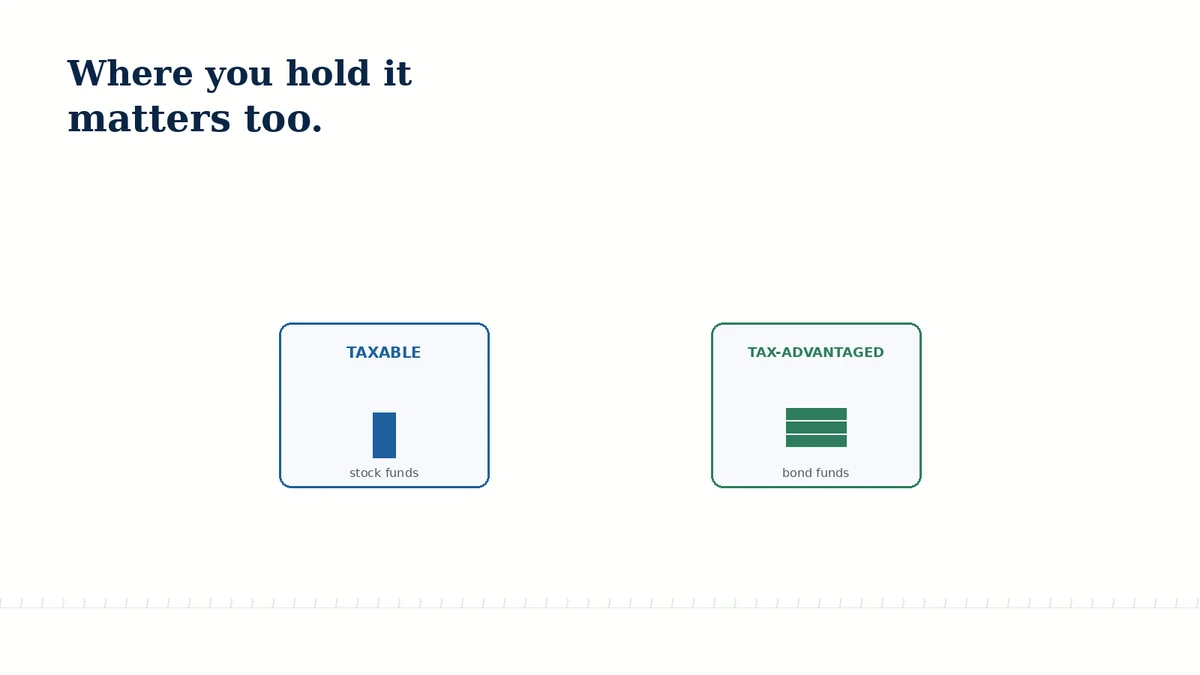
Where you hold a given fund can matter almost as much as which fund you choose, once you're investing across more than one account type. A bond fund generating regular taxable interest income behaves very differently in a taxable brokerage account than inside a Roth IRA — same fund, different tax outcome, based entirely on account placement. This guide covers the concept usually called "asset location," distinct from asset allocation.
Asset location vs. asset allocation: a key distinction
Asset allocation is the decision of how much to hold in stocks, bonds, and other asset classes overall (covered in Asset Allocation by Age). Asset location is a separate, subsequent decision: once you know your target allocation, which specific account (taxable, Traditional IRA, Roth IRA, 401(k)) should hold which piece of it. Two investors with an identical overall 70/30 stock/bond allocation across all their accounts combined can have very different tax outcomes depending on which account holds the bonds and which holds the stocks — this is what asset location addresses.
Why some fund types generate more tax drag than others
| Fund type | Typical tax efficiency in a taxable account | Why |
|---|---|---|
| Broad U.S. stock index funds/ETFs | Generally high | Low turnover, largely qualified dividends taxed at lower long-term capital gains rates |
| Total international stock index funds | Generally moderate-to-high | Similar to U.S. funds, sometimes with foreign tax credit considerations |
| Total bond market index funds | Generally lower | Interest income typically taxed as ordinary income, at potentially higher rates than qualified dividends |
| Actively managed funds with high turnover | Generally lower | Frequent trading can generate more realized capital gains distributions |
| REIT funds | Generally lower | REIT dividends are often taxed largely as ordinary income rather than qualified dividends |
A practical asset location framework
A commonly cited general framework, illustrative rather than personalized: hold bond funds and other less tax-efficient assets preferentially inside tax-advantaged accounts (Traditional IRA, 401(k), or Roth IRA) where their income isn't taxed annually; hold broad stock index funds and ETFs preferentially in taxable accounts, where their relatively favorable tax treatment (largely qualified dividends and low realized turnover) results in less drag. This framework becomes more relevant as your total portfolio grows across multiple accounts — for a portfolio held entirely within tax-advantaged accounts, asset location isn't a meaningful consideration at all, since none of it is currently subject to annual taxation regardless of fund type. Whether those dividends are automatically reinvested or taken as cash is a separate decision covered in Dividend Reinvestment (DRIP) Explained.
A worked example
Consider an investor with $200,000 total across a taxable brokerage account ($100,000) and a Traditional IRA ($100,000), targeting an overall 70% stock / 30% bond allocation ($140,000 stocks / $60,000 bonds across both accounts combined). One approach splits both accounts identically (70/30 in each). A more tax-efficient approach might place the full $60,000 bond allocation inside the Traditional IRA (where interest income isn't taxed annually) and hold $100,000 of stocks in the taxable account plus $40,000 of stocks in the remaining IRA space — achieving the same overall 70/30 allocation across the total portfolio, but reducing the annual taxable interest income that would otherwise be generated by bonds held in the taxable account. The total dollar amount and overall risk profile are identical in both approaches; only the tax efficiency differs.
ETFs and tax efficiency in taxable accounts specifically
As covered in What Is an ETF?, ETFs generally have a structural tax advantage over traditional mutual funds in taxable accounts specifically, due to the creation/redemption mechanism, which can reduce unwanted capital gains distributions relative to some traditional mutual funds. This is a secondary consideration to asset location itself — a tax-efficient stock index ETF held in a taxable account, combined with bonds held in a tax-advantaged account, combines both tax-efficiency levers together.
Tax-loss harvesting: a related but distinct concept
Tax-loss harvesting means selling an investment at a loss in a taxable account to realize a deductible capital loss, which can offset capital gains elsewhere in your portfolio (and, within IRS limits, a modest amount of ordinary income), while reinvesting the proceeds in a similar (but not "substantially identical," per IRS wash-sale rules) investment to maintain your market exposure. This is a distinct tactic from asset location — it's an opportunistic response to a specific investment's decline, rather than a permanent portfolio structure — and it requires care to avoid violating wash-sale rules, which can disallow the loss if you repurchase a substantially identical security within a specified window. Consider consulting a tax professional before implementing tax-loss harvesting, given its rule complexity.
Common mistakes
- Holding identical allocations in every account without considering tax efficiency. This misses a meaningful, no-added-risk opportunity to reduce total tax drag.
- Over-optimizing asset location at the expense of simplicity, for a small portfolio. For smaller balances, the tax savings may be modest relative to the added complexity — this matters more as your total portfolio grows.
- Violating wash-sale rules when tax-loss harvesting. Repurchasing a substantially identical security too soon after a loss sale can disallow the intended tax benefit.
- Confusing asset location with asset allocation. These are separate decisions; optimizing one doesn't substitute for deciding the other appropriately for your goals.
Frequently Asked Questions
Does asset location change my overall investment risk?
No — asset location only changes which account holds which piece of your portfolio; your total allocation across all accounts combined stays the same, so your overall risk profile is unaffected.
Is asset location worth the added complexity for a small portfolio?
For a smaller portfolio, particularly one held mostly in tax-advantaged accounts already, the added tax savings from asset location may be modest — it becomes more relevant as your taxable account balance grows.
Are index funds automatically tax-efficient?
Broad, low-turnover stock index funds tend to be relatively tax-efficient compared to high-turnover actively managed funds, but fund type still matters — bond index funds, for instance, are less tax-efficient in a taxable account regardless of being passively managed.
Should I consult a tax professional about this?
For anything beyond the general framework described here, especially tax-loss harvesting or complex multi-account situations, consulting a tax professional is a reasonable step — this article is educational, not personalized tax advice.
Summary
Asset location means placing less tax-efficient fund types (bonds, actively managed funds, REITs) preferentially in tax-advantaged accounts where possible, and more tax-efficient fund types (broad stock index funds and ETFs) in taxable accounts, to minimize the total tax drag across your entire portfolio. This is a distinct concept from asset allocation (how much you hold of each asset class) — asset location is about which account holds which piece, once your overall allocation is already decided.
This article is educational only and not personalized investment advice. See our full disclaimer.
Sources & References
Corrections & updates: No corrections logged since publication.