
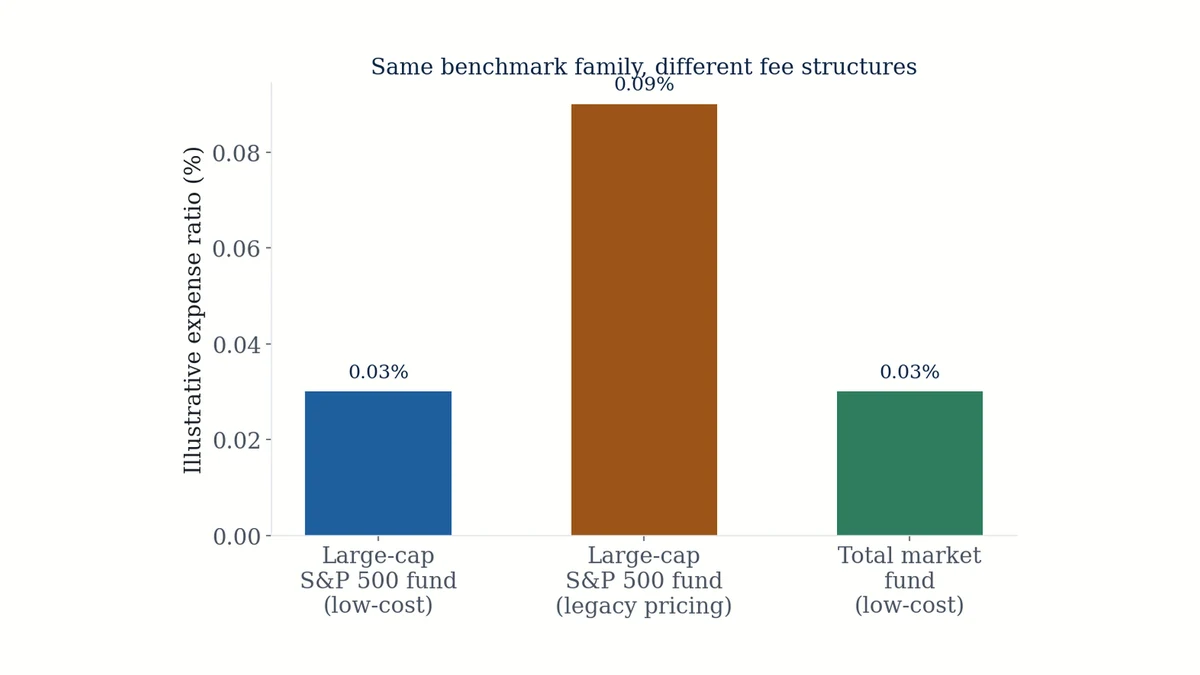
VOO, VTI, and SPY are three of the most commonly discussed U.S. stock ETFs, and they're often mentioned together as if they're interchangeable. Two of them track the same index; one tracks a meaningfully broader one. All three come from different providers with different fee structures and fund histories. This comparison walks through what's actually different, and — just as importantly — what isn't.
What each fund actually tracks
| Fund | Issuer | Tracks | Structure |
|---|---|---|---|
| VOO | Vanguard | S&P 500 (large-cap U.S.) | ETF |
| SPY | State Street | S&P 500 (large-cap U.S.) — same index as VOO | ETF (unit investment trust structure) |
| VTI | Vanguard | CRSP US Total Market Index (large, mid, and small-cap U.S.) | ETF |
VOO and SPY track the same benchmark — the S&P 500 — so their day-to-day performance is nearly identical, with any small differences coming from expense ratio and minor tracking variance rather than different underlying holdings. VTI tracks a distinctly broader index that includes thousands of additional smaller companies VOO and SPY don't hold at all, which is the real structural difference in this comparison, more than any difference between the three providers' execution.
Cost and structural differences
VOO and VTI, both from Vanguard, have historically carried very low, similar expense ratios. SPY, one of the oldest ETFs in existence, has historically charged a somewhat higher expense ratio than VOO despite tracking the identical index — a gap that exists partly because of SPY's older unit investment trust legal structure and its enormous trading volume among institutional and short-term traders, for whom a slightly higher expense ratio matters less than SPY's exceptional liquidity for large, fast trades. For a long-term buy-and-hold retail investor, that liquidity advantage is largely irrelevant, which is why VOO (or another low-cost S&P 500 ETF) is more commonly recommended for long-term holding, while SPY remains heavily used by institutional and active traders for its trading characteristics rather than its cost efficiency.
Always verify current expense ratios directly from each provider before investing, since fee structures can change and this comparison shouldn't be treated as a live pricing source.
Overlap: what you already own if you hold VTI
Because VTI is market-cap weighted and large-cap companies dominate total U.S. market value, VTI's holdings overlap enormously with VOO and SPY's — the same largest companies make up a substantial share of all three funds' weight. Holding both VOO and VTI together doesn't meaningfully increase diversification beyond what VTI alone provides, since VTI already includes essentially the same large-cap exposure VOO offers, plus additional small and mid-cap companies on top. Investors sometimes hold both without realizing the overlap; understanding this can simplify a portfolio meaningfully, in many cases down to a single total-market fund rather than two overlapping ones.
Historical performance: how similar are they really?
Because VTI includes small and mid-cap companies in addition to the large-caps that dominate the S&P 500, its performance can diverge modestly from VOO and SPY in periods when smaller companies notably outperform or underperform large companies — though because large-caps dominate VTI's weighting too, the divergence has historically tended to be relatively modest over most multi-year periods rather than dramatic. Past performance for any of these funds is not a reliable indicator of how the gap will behave in the future; the structural point — VTI includes more companies, VOO and SPY don't — is the reliable, permanent fact, whereas historical return comparisons will keep changing as new data comes in.
Which one is the more common default recommendation, and why
Among educators and independent commentary broadly favoring low-cost index investing, a low-fee total U.S. market fund (like VTI) or a low-fee S&P 500 fund (like VOO) are both commonly cited as reasonable single-fund starting points, precisely because of their low cost and broad within-category diversification. SPY tends to be discussed more in the context of active or short-term trading, due to its trading characteristics, rather than as a long-term core holding recommendation — not because it's a "bad" fund, but because its design historically optimized for a different use case than buy-and-hold investing.
What a small fee gap is actually worth over time
To make the VOO-vs-SPY expense ratio gap concrete rather than abstract: using illustrative figures of a 0.03% expense ratio (representative of VOO's historical pricing) versus 0.09% (representative of SPY's historical pricing), on a $10,000 starting investment plus $400 monthly at a 7% gross return over 20 years, the lower-fee fund projects to roughly $247,800 versus roughly $245,800 for the higher-fee fund — a gap of about $2,000 from that fee difference alone, holding everything else identical. It's a smaller gap than you'd see comparing an index fund to an actively managed fund (see Expense Ratios Explained for that larger comparison), which is worth keeping in perspective: the VOO-vs-SPY decision is a genuine but modest cost optimization, not the most consequential fee decision an investor will make. Always verify current expense ratios directly with each provider rather than relying on the illustrative figures above, which can change.
Common mistakes
- Assuming VOO and SPY have different holdings. They track the identical index — the differences are in cost and fund structure, not composition.
- Holding VOO and VTI as if they're meaningfully diversifying each other. The overlap is substantial; consider whether one alone meets your goal.
- Choosing SPY for long-term holding based on its popularity or trading volume. High trading volume benefits active traders more than long-term holders, for whom the expense ratio matters more.
- Not verifying current expense ratios before investing. Fee figures change; check each provider's current data directly.
Frequently Asked Questions
Is VTI riskier than VOO?
Not necessarily 'riskier' in a simple sense, but its inclusion of small and mid-cap companies gives it a somewhat different risk and return profile than VOO's large-cap-only exposure — small-cap stocks have historically shown higher volatility than large-caps as a category.
Can I convert SPY shares to VOO without selling?
No — they're distinct funds from different issuers; moving from one to the other requires selling SPY and buying VOO, which can trigger a taxable event in a taxable account. Consider consulting a tax professional before making this kind of change.
Do VOO and SPY pay the same dividends?
Since they track the same index and hold essentially the same companies, their dividend income is very similar, though exact distribution amounts and timing can differ slightly by fund. What you do with that dividend income — automatic reinvestment or taking it as cash — is covered in Dividend Reinvestment (DRIP).
Which is better for a Roth IRA: VOO or VTI?
Since tax efficiency differences between structures matter less inside a Roth IRA, the decision mainly comes down to scope — large-cap only (VOO) versus the full U.S. market (VTI) — which is a personal allocation choice rather than one fund being objectively superior.
Summary
VOO and SPY both track the S&P 500 — the same underlying index — but come from different providers (Vanguard and State Street, respectively) with a meaningful expense ratio gap between them. VTI tracks a broader total U.S. stock market index, including small and mid-cap companies that VOO and SPY exclude entirely. For a long-term investor, VOO's low cost makes it a common default among S&P 500 options, while the choice between VOO and VTI is really a choice about scope — large-cap only, versus the full U.S. market — rather than a question of one being objectively better.
This article is educational only and not personalized investment advice. See our full disclaimer.
Sources & References
Corrections & updates: No corrections logged since publication. Note: expense ratios and fund figures cited are illustrative of typical recent levels — always verify current figures directly with the fund issuer before investing, as fees and fund details can change.