
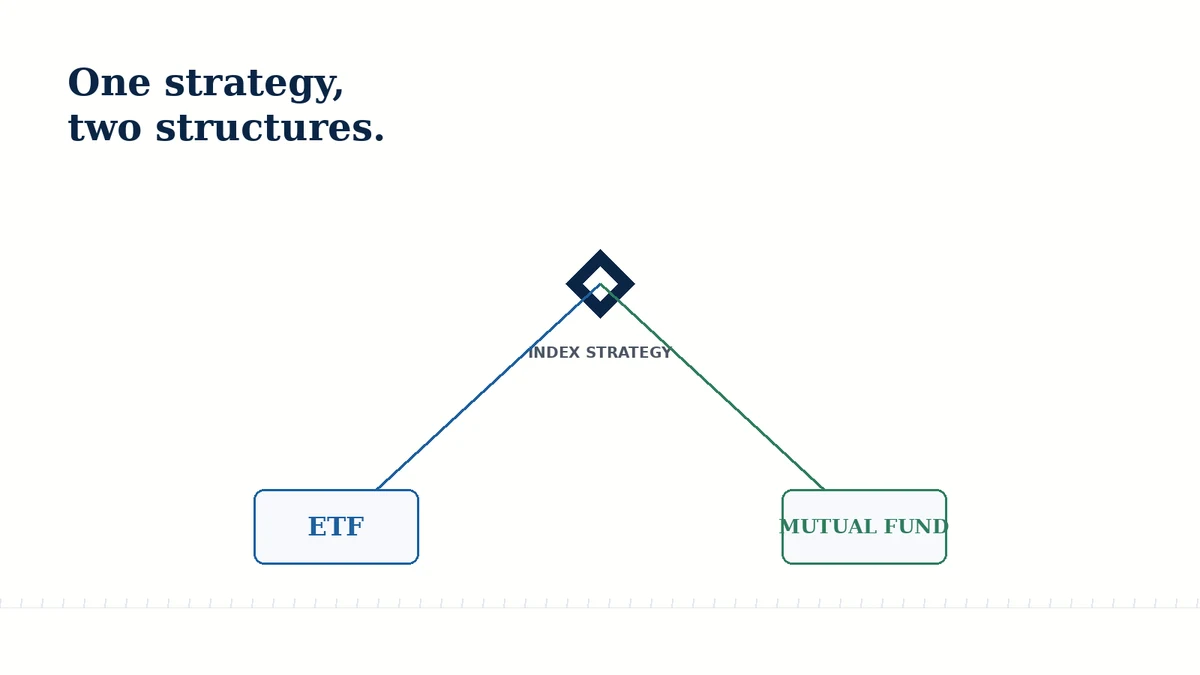
These three terms get used interchangeably online, which causes real confusion, because they're not actually three parallel options. "Index fund" describes a strategy — tracking a benchmark. "ETF" and "mutual fund" describe structures — how a fund is priced and traded. A fund can be an index ETF, an actively managed ETF, an index mutual fund, or an actively managed mutual fund. Untangling which axis you're actually comparing is the fastest way to make sense of this space.
The two separate axes people conflate
It helps to think of fund choice as two independent decisions layered on top of each other, not one three-way decision:
| Index strategy | Active strategy | |
|---|---|---|
| ETF structure | Index ETF (e.g., a fund tracking the S&P 500, trading on an exchange) | Actively managed ETF (a manager-selected portfolio, still exchange-traded) |
| Mutual fund structure | Index mutual fund (tracks a benchmark, priced once daily) | Actively managed mutual fund (manager-selected, priced once daily) |
All four combinations exist and are commonly available. When someone asks "should I buy an index fund or an ETF," they're usually actually asking one of two different questions: "should I go with a benchmark-tracking strategy or an actively managed one" (the index vs. active question), or "should I use the ETF structure or the traditional mutual fund structure for my index strategy" (the structure question). These deserve separate answers.
Question one: index strategy or active strategy?
This is fundamentally a cost and probability question, covered in depth in What Is an Index Fund?. In short: index strategies typically charge lower fees because there's no research team making active bets, and a large body of long-run performance data has shown the median active fund underperforming its benchmark after fees, in most categories over most multi-year periods. This doesn't mean no active fund ever outperforms — it means predicting which one will, in advance, is difficult, and the fee gap works against you by default regardless of the outcome.
Question two: ETF structure or mutual fund structure?
Assuming you've chosen an index strategy, the remaining question is purely structural, covered in depth in What Is an ETF?. The short version:
- ETFs generally have lower or no minimum investment (often just the price of one share, or a fraction of a share if your broker supports fractional shares), trade throughout the day, and tend to be more tax-efficient in taxable brokerage accounts.
- Traditional index mutual funds often require a minimum initial investment (commonly $1,000–$3,000, though this varies by provider and fund), price once daily, and can be simpler for automatic recurring investment setups with some providers.
For most investors starting out today, especially with smaller account balances, the ETF structure's low or no minimum tends to make it the more accessible starting point — but if your employer's 401(k) or a specific provider only offers the mutual fund version of a given index strategy, that's a perfectly reasonable way to access the same underlying strategy.
A concrete example: three ways to buy the same index
Say you want exposure to the S&P 500. You could access essentially the same underlying index through: an S&P 500 index ETF, an S&P 500 index mutual fund, or (much less commonly) an actively managed fund that happens to closely resemble the S&P 500's composition while charging active-management fees for the similarity. The first two give you the same market exposure through different structures; the expense ratio and tracking accuracy, not the structure, are what should drive your choice between them. The third defeats the purpose of index investing's cost advantage while offering little differentiation in exposure — a combination worth watching out for.
Where the lines blur: index-adjacent strategies
Some funds sit in a gray area: "enhanced index" funds make small active adjustments around an index; "smart beta" or "factor" funds track a rules-based index that deliberately weights differently than plain market-cap weighting (for example, tilting toward smaller companies or higher-dividend companies). These are still rules-based and typically lower-cost than fully active management, but they're not simply tracking a plain-vanilla benchmark either. They're worth understanding as a distinct middle category rather than assuming "index" always means the simplest, broadest possible exposure.
Common mistakes
- Assuming "ETF" means "index fund." Actively managed ETFs exist and have grown significantly — check the strategy, not just the structure.
- Choosing a structure based on habit rather than account type. A taxable account and a 401(k) can reasonably call for different structural choices, per the tax-efficiency discussion above.
- Paying active-fund fees for index-like exposure. If a fund's holdings closely resemble a broad index, its fee should generally resemble an index fund's fee too.
- Overthinking the ETF-vs-mutual-fund choice. For most long-term investors, the strategy (index vs. active, and which index) matters far more than the structural wrapper.
Frequently Asked Questions
Is Vanguard's Total Stock Market Index Fund an ETF or a mutual fund?
Vanguard offers this strategy in both structures — VTI is the ETF share class, and VTSAX is the mutual fund share class. Both track the same underlying index.
Which is cheaper, an ETF or a mutual fund version of the same index?
It varies by provider, but for many major low-cost providers, the ETF and mutual fund versions of the same index strategy now charge very similar or identical expense ratios.
Can I convert a mutual fund to an ETF, or vice versa?
Some providers allow converting their own mutual fund share class to the equivalent ETF share class without a taxable event; this isn't universal, so check with your specific fund provider.
Do actively managed ETFs defeat the purpose of low-cost investing?
Not automatically — but they typically charge higher fees than index ETFs, so the same active-vs-index cost and performance tradeoff applies regardless of the trading structure.
Summary
"Index fund" is a strategy — tracking a benchmark rather than trying to beat it. "ETF" and "mutual fund" are structures — how the fund is priced and traded. Most of the meaningful comparisons people are actually trying to make are index vs. active (a cost and philosophy question) or ETF vs. traditional mutual fund (a trading-mechanics and minimum-investment question) — not a genuine three-way choice. Once you separate those two questions, selecting a specific fund becomes much more straightforward.
This article is educational only and not personalized investment advice. See our full disclaimer.
Sources & References
Corrections & updates: No corrections logged since publication.