
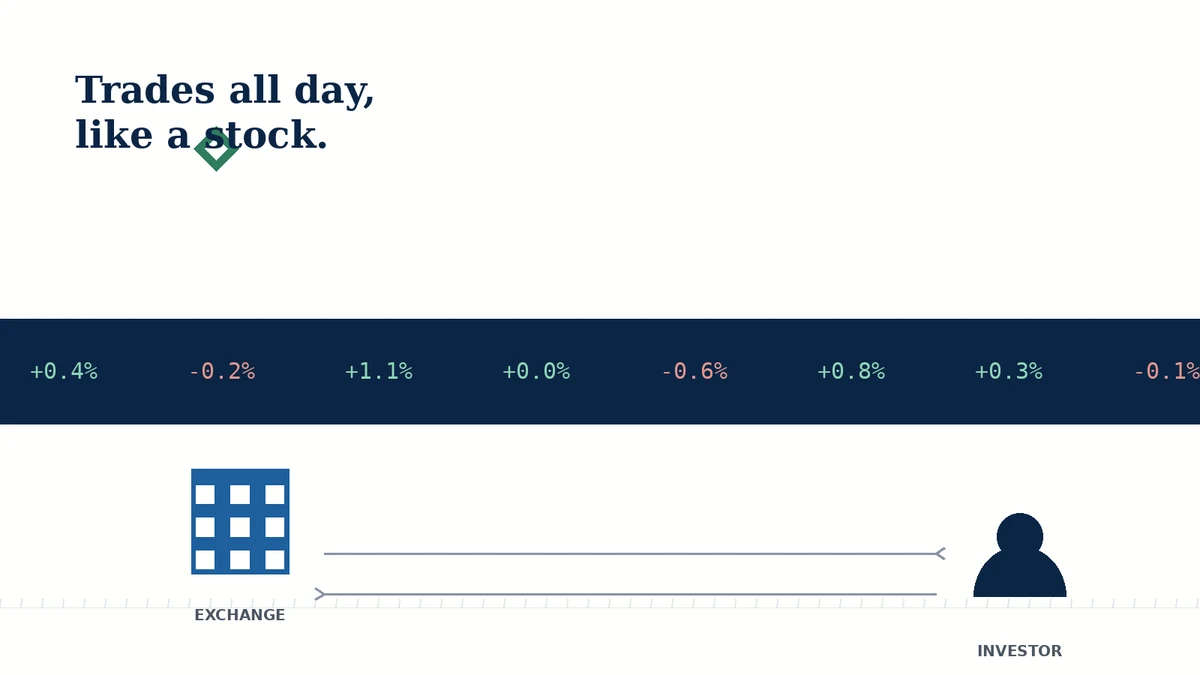
An ETF, or exchange-traded fund, holds a basket of securities — similar to a mutual fund — but trades on a stock exchange throughout the day, the same way an individual stock does. That trading mechanism is the defining feature of an ETF, and it's the source of nearly every practical difference between ETFs and traditional mutual funds.
Most ETFs today are index ETFs, tracking a benchmark the same way an index mutual fund does. This guide focuses on the ETF structure itself — how it's priced, how it trades, and where that structure genuinely matters versus where it's a distinction without a practical difference for a long-term investor.
How ETF shares are created and traded
ETF shares are created and redeemed through a mechanism involving large institutional entities called authorized participants, who exchange baskets of the underlying securities for new ETF shares (or vice versa) directly with the fund. This "creation/redemption" process keeps an ETF's market price closely aligned with the value of its underlying holdings, because authorized participants can profit from correcting any meaningful gap between the two — a process that happens continuously and largely invisibly to individual investors.
As an individual investor, you don't interact with this mechanism directly. You simply buy and sell ETF shares through a brokerage account, the same way you'd buy a stock, at whatever price the market is currently offering during trading hours.
ETFs vs. mutual funds: the practical differences
| Feature | ETF | Traditional mutual fund |
|---|---|---|
| Pricing | Continuous, throughout trading day | Once daily, after market close (NAV) |
| How you buy it | Through a brokerage, like a stock | Directly from the fund company or through a brokerage |
| Minimum investment | Typically one share | Often $1,000–$3,000 minimum for many funds |
| Typical tax efficiency | Often more tax-efficient in taxable accounts | Can generate more taxable capital gains distributions |
The tax-efficiency difference stems from the creation/redemption mechanism: ETFs can generally remove appreciated securities from the fund without triggering a taxable sale, in a way traditional mutual funds usually cannot. This matters primarily in taxable brokerage accounts — inside a 401(k) or IRA, this specific advantage is mostly irrelevant, since those accounts aren't taxed on distributions in the same way. For a fuller breakdown of how the ETF and mutual fund structures compare beyond tax treatment, see Index Funds vs. ETFs vs. Mutual Funds.
Does intraday trading actually matter to you?
For a long-term, buy-and-hold investor making periodic contributions, the ability to trade an ETF throughout the day rarely provides a meaningful advantage — and it can introduce a temptation to trade more frequently than a long-term strategy calls for, based on short-term price movements. Mutual funds' once-daily pricing was designed for buy-and-hold investing in the first place; the "limitation" mostly isn't one, for this use case.
Where trading flexibility genuinely matters: if you need to execute a large trade at a specific, known price during the day (rather than an unknown closing price), or if you're using limit orders or other order types unavailable on mutual funds. For most retirement savers dollar-cost averaging into a diversified fund, this is a secondary consideration behind expense ratio and tracking accuracy.
Bid-ask spreads and liquidity
One ETF-specific cost mutual fund investors don't encounter is the bid-ask spread — the small gap between the price a buyer is willing to pay and a seller is willing to accept at any given moment. For large, heavily traded ETFs tracking major indexes like the S&P 500 or total U.S. stock market, this spread is typically a fraction of a cent per dollar and negligible for long-term investors. For smaller, thinly traded, or niche ETFs, spreads can be wider, effectively adding a small extra cost to each trade. Checking a fund's average daily trading volume is a reasonable quick check before investing in a less mainstream ETF.
Pros and cons
- Often lower minimum investment (one share)
- Generally strong tax efficiency in taxable accounts
- Transparent, typically published holdings daily
- Wide selection tracking nearly any index or sector
- Bid-ask spreads on less-liquid ETFs
- Intraday tradability can encourage overtrading
- Share price won't divide evenly into a target dollar amount unless your broker supports fractional shares
The many kinds of ETFs beyond broad index funds
"ETF" describes a trading structure, not a strategy — and that's a common source of confusion, because the ETF wrapper has been used for a very wide range of strategies, not all of which carry the same risk or serve the same purpose as a broad-market index fund. Understanding these categories helps you avoid accidentally buying something quite different from what you intended.
- Broad-market index ETFs — track a wide benchmark like the total U.S. stock market or S&P 500. This is what most of this site focuses on.
- Sector and industry ETFs — track a narrower slice, such as technology or healthcare companies only. These carry more concentrated risk than a broad-market fund.
- Bond ETFs — track baskets of government or corporate bonds, generally lower-volatility than stock ETFs but not risk-free.
- International and emerging-market ETFs — track non-U.S. indexes, adding geographic diversification along with currency and country-specific risk.
- Thematic ETFs — track a narrow theme (e.g., a specific emerging technology), often with higher fees and higher volatility, and a shorter track record than broad-market funds.
- Leveraged and inverse ETFs — designed to deliver a multiple of, or the inverse of, a daily index return. These are built for short-term trading, not long-term holding, and can behave very differently from their headline index over longer periods due to daily rebalancing.
For most long-term investors building a core portfolio, broad-market index ETFs (and, to a lesser extent, bond and international ETFs used for diversification) are the relevant category. The other types aren't necessarily "bad," but they solve different problems and carry different risk profiles than the phrase "just an ETF" might suggest.
How to evaluate a specific ETF before buying
Before buying any ETF, it's worth checking a short, consistent set of things directly in the fund's prospectus or fact sheet rather than relying on a ticker's reputation:
- What index does it actually track? Read the stated benchmark, not just the fund's name — similar-sounding funds can track meaningfully different indexes.
- What's the expense ratio? Compare it to other funds tracking the same or a similar index; wide differences for essentially the same exposure are common and avoidable.
- How closely has it tracked its benchmark historically? A fund's "tracking error" — the gap between the fund's return and the index's return, beyond what the expense ratio alone explains — is a signal of how well it's actually run.
- How much does it trade daily? Average daily volume gives a sense of likely bid-ask spread costs.
- How large is the fund? Very small funds carry some risk of being shut down (liquidated) if they don't attract enough assets, which can trigger an unplanned taxable event for holders in a taxable account.
None of these checks take more than a few minutes using a fund's published fact sheet, and doing them consistently is a more reliable habit than assuming a well-known provider's fund is automatically the cheapest or best-tracking option in its category.
ETFs in taxable accounts vs. retirement accounts
The tax-efficiency advantage often cited for ETFs is real but conditional — it matters in a taxable brokerage account, where capital gains distributions create a tax bill even if you didn't sell anything, and it's largely irrelevant inside a 401(k), Traditional IRA, or Roth IRA, where investment growth isn't taxed year to year regardless of fund structure.
Practically, this means the ETF-vs-mutual-fund tax argument shouldn't be the deciding factor for retirement account investing — expense ratio and index choice matter far more there. In a taxable account, all else being equal, the tax-efficiency edge is a legitimate reason to lean toward an ETF (or a mutual fund share class specifically designed for tax efficiency), especially for a fund you plan to hold for a long time and where avoiding unnecessary annual capital gains distributions has real, compounding value.
Common mistakes with ETFs
- Placing market orders on thinly traded ETFs. Using a limit order avoids paying an unexpectedly wide spread.
- Trading intraday out of habit, not strategy. The ability to trade during the day doesn't mean you should, for a long-term portfolio.
- Confusing an ETF's ticker with its strategy. Similar-sounding tickers can track very different indexes — always confirm via the fund's actual prospectus.
- Ignoring trading volume for niche or leveraged ETFs. These carry additional structural risks well beyond typical broad-market index ETFs.
Frequently Asked Questions
Are ETFs riskier than mutual funds?
Not inherently. A broad-market index ETF and a broad-market index mutual fund tracking the same index carry essentially the same underlying market risk — the structural differences are about trading and tax mechanics, not risk level.
Do ETFs pay dividends?
Yes, if the underlying securities pay dividends, an ETF typically distributes them to shareholders, usually quarterly.
Can I lose more than I invest in an ETF?
Not with a standard, unleveraged ETF used in a normal cash brokerage account — your risk is limited to your invested amount. Leveraged and inverse ETFs carry different, more complex risk profiles.
Is Vanguard's VOO an ETF or a mutual fund?
VOO is an ETF share class tracking the S&P 500. Vanguard also offers a mutual fund version of the same underlying strategy for some of its index funds.
Summary
An ETF is a fund structure that trades on an exchange throughout the day, priced continuously by the market, rather than once daily like a traditional mutual fund. For a long-term, buy-and-hold investor, the intraday tradability rarely matters in practice — what matters more is the fund's underlying index, expense ratio, and how well it tracks its benchmark. ETFs are widely used for index investing today largely because of tax efficiency and low minimum investment requirements, not primarily because of the trading mechanism itself.
This article is educational only and not personalized investment advice. See our full disclaimer.
Sources & References
Corrections & updates: No corrections logged since publication.