
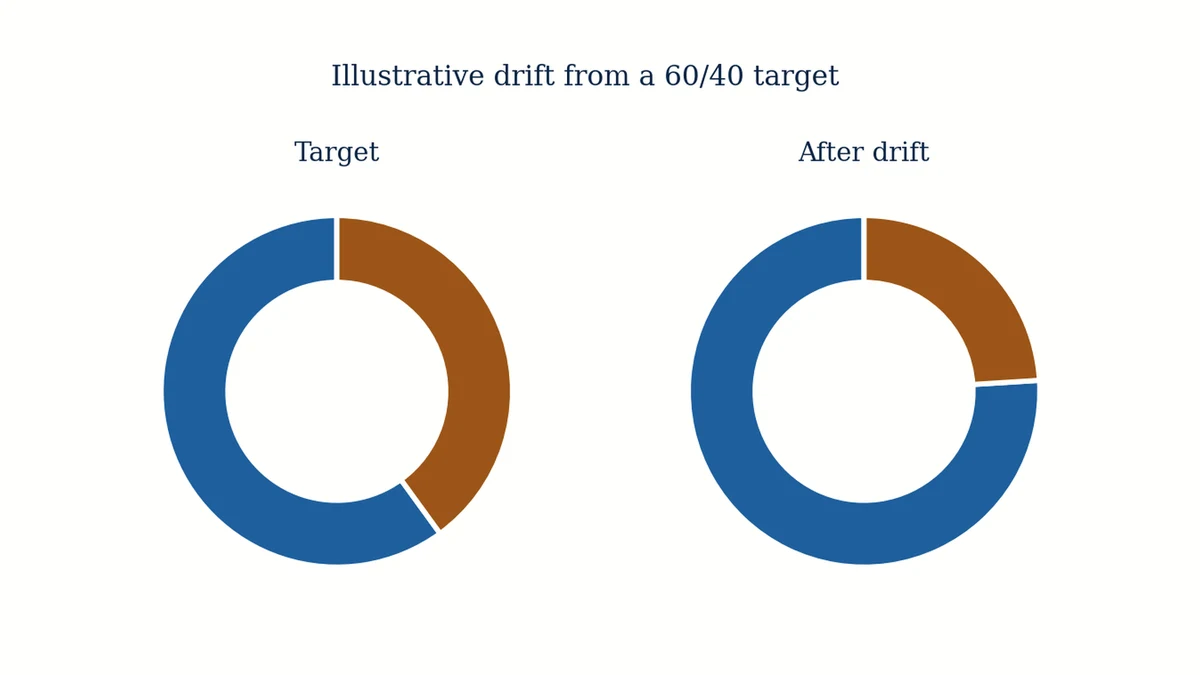
Rebalancing means adjusting your portfolio back to its target allocation after market movements have caused it to drift. It sounds like a minor maintenance task, and mechanically it is — but skipping it entirely, for long enough, can leave a portfolio meaningfully more or less risky than originally intended, often without the investor realizing it happened gradually.
Why portfolios drift in the first place
If you set a target of 70% stocks and 30% bonds, and stocks subsequently grow faster than bonds over the following year, your actual allocation might shift to, say, 76% stocks and 24% bonds — not because you made any new decision, but simply because the stock portion grew more. Left unaddressed over multiple years of a strong stock market, this drift can compound into a portfolio that's meaningfully more aggressive (and vulnerable to a downturn) than originally intended, even though no individual decision along the way seemed significant. Staying close to target is particularly important heading into retirement, since an unrebalanced, overly stock-heavy portfolio combined with a poorly timed downturn right as withdrawals begin is a central driver of what's called sequence-of-returns risk.
Two rebalancing triggers: calendar-based and threshold-based
| Approach | How it works | Tradeoff |
|---|---|---|
| Calendar-based | Rebalance on a fixed schedule — e.g., every January | Simple and predictable; may rebalance even when drift is minor, or miss significant drift between check-ins |
| Threshold-based | Rebalance whenever an asset class drifts a set amount (e.g., 5 percentage points) from target | Responds directly to actual drift; requires more frequent monitoring to catch the threshold being crossed |
Many investors use a hybrid: checking allocation on a calendar schedule (e.g., annually) and rebalancing only if a meaningful threshold has been crossed at that check-in, combining the simplicity of a fixed schedule with the responsiveness of a threshold trigger.
Method 1: Selling and buying to rebalance
The most direct method: sell shares of the overweighted asset class and use the proceeds to buy the underweighted one, bringing the portfolio back to its target percentages immediately. This works in any account type, but in a taxable brokerage account, selling appreciated shares can trigger a taxable capital gain — worth factoring into the decision, and a good reason to consider the tax-efficient rebalancing methods below first when possible. Inside a tax-advantaged account like a 401(k) or IRA, this concern doesn't apply, since trades within those accounts aren't taxed as they occur.
Method 2: Rebalancing with new contributions
A more tax-efficient approach, especially in a taxable account, is directing new contributions toward whichever asset class is currently underweighted, rather than splitting new money proportionally across all funds as usual. This gradually pulls the portfolio back toward its target without requiring any sales at all, avoiding a taxable event entirely. This method works best for portfolios still receiving regular new contributions large enough, relative to the portfolio's size, to meaningfully shift the allocation within a reasonable timeframe — it becomes less practical for a large, mature portfolio no longer receiving significant new contributions relative to its total size.
A worked example
Say your target allocation is 60% stocks / 40% bonds on a $50,000 portfolio ($30,000 stocks, $20,000 bonds). After a strong year for stocks, your portfolio is now worth $58,000, with stocks at $38,000 (about 65.5%) and bonds still at $20,000 (about 34.5%) — stocks have drifted roughly 5.5 percentage points above target. To rebalance by selling and buying, you'd sell approximately $3,200 of stocks and buy approximately $3,200 of bonds, bringing the portfolio back to a 60/40 split at its new $58,000 total value. Alternatively, if you're still contributing $500 a month, you could direct those contributions entirely to bonds for a period, gradually closing the gap without any sales.
Rebalancing across multiple accounts
If you hold investments across more than one account (a 401(k), an IRA, and a taxable brokerage account, for instance), it's generally more efficient to think about your target allocation across your total portfolio rather than separately within each individual account. This often means placing less tax-efficient asset classes (like bonds, which generate regularly taxed interest income) preferentially within tax-advantaged accounts where possible, and using taxable accounts more for tax-efficient holdings like broad stock index funds — a concept covered further in Tax-Efficient Index Fund Investing.
Common mistakes
- Rebalancing too frequently. Constant rebalancing in response to minor day-to-day fluctuations adds unnecessary transaction activity and, in taxable accounts, potential tax cost, without meaningful benefit.
- Never rebalancing at all. The opposite extreme allows meaningful, unintended drift to accumulate over years.
- Ignoring tax consequences in taxable accounts. Selling to rebalance can trigger capital gains; consider contribution-based rebalancing or accounts placement first where practical.
- Rebalancing based on market predictions rather than a defined target. Rebalancing back to a pre-set target is a discipline exercise, not an attempt to time the market — conflating the two undermines the strategy's purpose.
Frequently Asked Questions
How often should I rebalance?
A common approach is checking roughly once a year and rebalancing if allocation has drifted a meaningful amount (often cited around 5 percentage points) from target — more frequent rebalancing is generally unnecessary for a long-term portfolio.
Does rebalancing cost money?
In a taxable account, selling to rebalance can trigger capital gains tax; in a tax-advantaged account like a 401(k) or IRA, trades within the account aren't taxed as they occur. Some brokerages also offer commission-free trading on stocks and ETFs, reducing direct transaction costs.
Can rebalancing improve my returns?
Rebalancing is primarily a risk-management discipline, not a return-enhancement strategy, though some analyses suggest it can provide a modest structural benefit over very long periods by systematically buying relatively lower-priced assets and trimming relatively higher-priced ones.
Do target-date funds rebalance automatically?
Yes — target-date funds handle rebalancing internally as part of their design, which is one of their key conveniences for investors who prefer not to manage this manually.
Summary
Because different asset classes grow at different rates, a portfolio's actual allocation drifts away from its target over time — commonly toward more stocks after a strong stock market run, increasing risk beyond what was originally intended. Rebalancing back to target, whether by selling the overweighted asset and buying the underweighted one, or by directing new contributions toward the underweighted asset, keeps the portfolio's risk level aligned with the investor's actual intention. A common approach is checking allocation roughly once a year, or when it drifts a meaningful amount (often cited around 5 percentage points) from target.
This article is educational only and not personalized investment advice. See our full disclaimer.
Sources & References
Corrections & updates: No corrections logged since publication.