
Asset allocation — the split between stocks, bonds, and other asset classes in a portfolio — has more influence on a portfolio's overall risk and return characteristics than the specific funds chosen within each category. A common pattern in allocation guidance is a higher stock allocation earlier in life, gradually shifting toward more bonds as retirement approaches. This guide explains the reasoning behind that pattern and its real limitations as a one-size-fits-all rule.
The core logic: time horizon and recovery capacity
Stocks have historically delivered higher long-run average returns than bonds, but with substantially more volatility — including periods of significant, multi-year decline. An investor with decades until they need the money has time to ride out a downturn and benefit from the market's historical tendency to recover and grow over long periods; an investor who needs the money within the next few years does not have that same buffer, and a poorly timed downturn right before a planned withdrawal can meaningfully impact their actual outcome, since there's less time to recover before the money is needed. This danger is often called sequence-of-returns risk, and it's a central reason retirement-age allocations tend to hold more bonds than earlier-career allocations. This time-horizon logic — not an inherent property of any specific age — is what actually drives the traditional "more bonds as you age" pattern; age is simply a common (imperfect) proxy for time horizon in an increasingly automated rule of thumb.
Common rule-of-thumb formulas
| Formula | Age 25 | Age 45 | Age 65 |
|---|---|---|---|
| "100 minus age" in stocks | 75% | 55% | 35% |
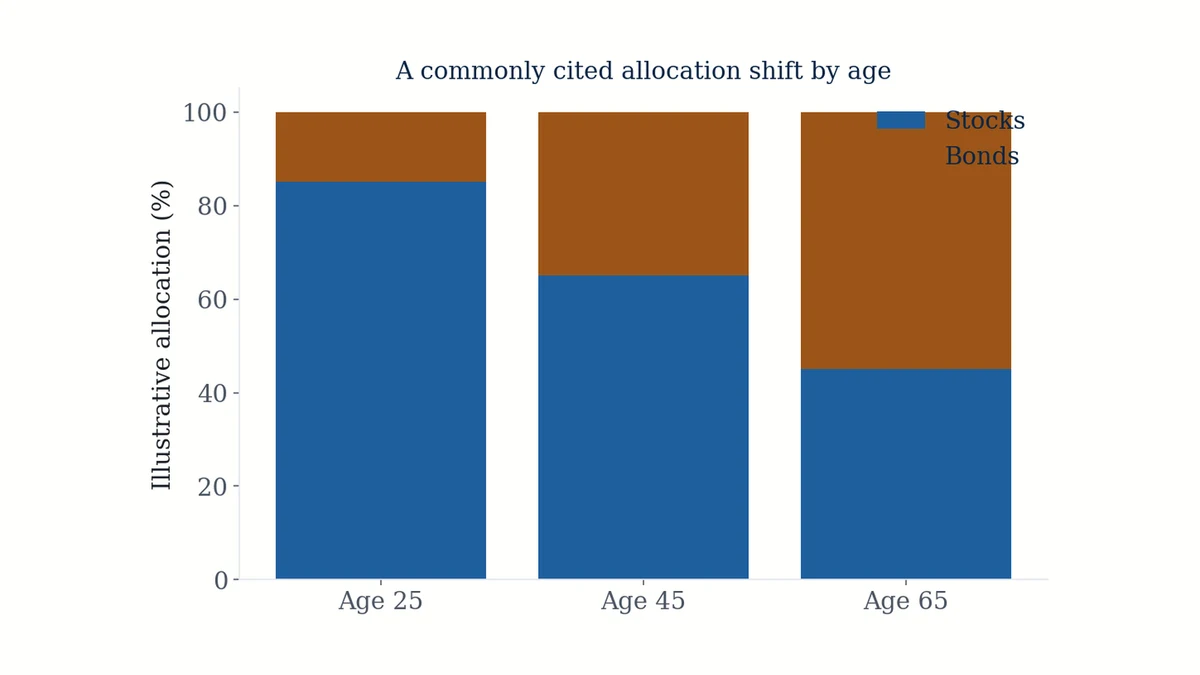
| "110 minus age" in stocks | 85% | 65% | 45% |
| "120 minus age" in stocks | 95% | 75% | 55% |
These formulas have shifted over time toward higher stock allocations (from "100 minus age" toward "110" or "120 minus age") partly reflecting longer average life expectancies and longer typical retirement periods, meaning even a 65-year-old often still has a fairly long remaining investment horizon covering their retirement years, not just their date of retirement. None of these formulas is more objectively "correct" than the others — they're competing simplifications of the same underlying time-horizon logic.
Why age alone is an incomplete picture
Age is a proxy for time horizon, but it's an imperfect one, because time horizon and risk capacity depend on more than birth year:
- Other income sources — a guaranteed pension or other stable income can reduce reliance on portfolio withdrawals, supporting a higher stock allocation even closer to retirement.
- Actual retirement timeline — someone planning to work well past a traditional retirement age has a longer effective horizon than their age alone suggests.
- Emotional risk tolerance — an allocation that's "correct" on paper but leads to panic-selling during a downturn is worse in practice than a more conservative allocation the investor can actually stick with.
- Specific goals within a portfolio — money earmarked for a near-term goal (a house down payment in three years) warrants a different, more conservative allocation than retirement savings, even for the same person at the same age.
How allocation shifts in practice: gradual, not abrupt
Traditional guidance suggests shifting allocation gradually over years or decades, not making sudden, large changes in response to a specific birthday or a single market event. Target-date retirement funds implement this gradual shift automatically and continuously, which is part of their appeal for investors who prefer not to manage this adjustment manually — though it's worth understanding that a target-date fund's specific "glide path" (how quickly and in what pattern it shifts allocation) varies somewhat between fund providers, so it's worth checking a specific fund's approach rather than assuming they're all identical. See What Is a Target-Date Fund? for a full breakdown of how these funds work and when one reasonably fits, and 3-Fund Portfolio vs. Target-Date Fund for a direct comparison against managing this allocation yourself.
A worked example: reviewing allocation at three life stages
Consider an investor using a "110 minus age" framework. At 25, an 85% stock / 15% bond split reflects a very long horizon and high recovery capacity. By 45, having built substantial savings and now roughly 20 years from a target retirement, they shift to roughly 65% stock / 35% bond — still growth-oriented, but somewhat more conservative. By 65, near or at retirement, they hold roughly 45% stock / 55% bond, balancing continued growth (since retirement itself can last decades) against reduced tolerance for a severe near-term decline right as withdrawals begin. At each stage, the shift is gradual rather than a single dramatic reallocation, and the specific percentages are illustrative starting points a real investor would adjust based on their own complete financial picture. In practice, the bond portion of a split like this is usually implemented with a broad bond index fund rather than individual bonds — see that guide for how these funds actually work and what they hold.
Common mistakes
- Applying a rule-of-thumb formula without considering personal circumstances. These formulas are reasonable starting points, not personalized recommendations.
- Making large, reactive allocation changes based on short-term market moves. This tends to work against long-term strategy rather than support it.
- Ignoring risk tolerance in favor of a "textbook" allocation. An allocation you can't emotionally sustain through a downturn isn't actually the right allocation for you, regardless of what a formula suggests.
- Treating retirement as a single cliff-edge date rather than the start of a decades-long withdrawal period. This is part of why even near-retirement allocations often still include a meaningful stock component.
Frequently Asked Questions
What's the 'right' asset allocation for my age?
There's no single correct answer — it depends on your time horizon, other income sources, and personal risk tolerance in addition to age. Rule-of-thumb formulas are reasonable starting reference points, not personalized recommendations; consider consulting a financial professional for guidance specific to your situation.
Should I include bonds in my portfolio in my 20s?
Some young investors hold 0% bonds given a very long time horizon; others prefer a small bond allocation for reduced volatility. Both are reasonable choices depending on personal risk tolerance.
Do target-date funds handle this automatically?
Yes — a target-date fund automatically adjusts its stock/bond mix over time according to its own glide path, without requiring manual rebalancing by the investor, though the specific glide path varies by provider.
How often should I revisit my allocation?
Many investors review roughly once a year, or after a significant life change (new job, marriage, approaching retirement), rather than reacting to short-term market movements.
Summary
A commonly cited pattern for long-term investors is a higher stock allocation when young (with a long time horizon to recover from downturns) shifting gradually toward more bonds as retirement nears (reducing the portfolio's vulnerability to a poorly timed downturn just before the money is needed). Simple rules of thumb like "110 minus your age in stocks" are a starting reference point, not a personalized formula — actual risk tolerance, other income sources, and specific goals should inform the final allocation more than age alone.
This article is educational only and not personalized investment advice. See our full disclaimer.
Sources & References
Corrections & updates: No corrections logged since publication.