
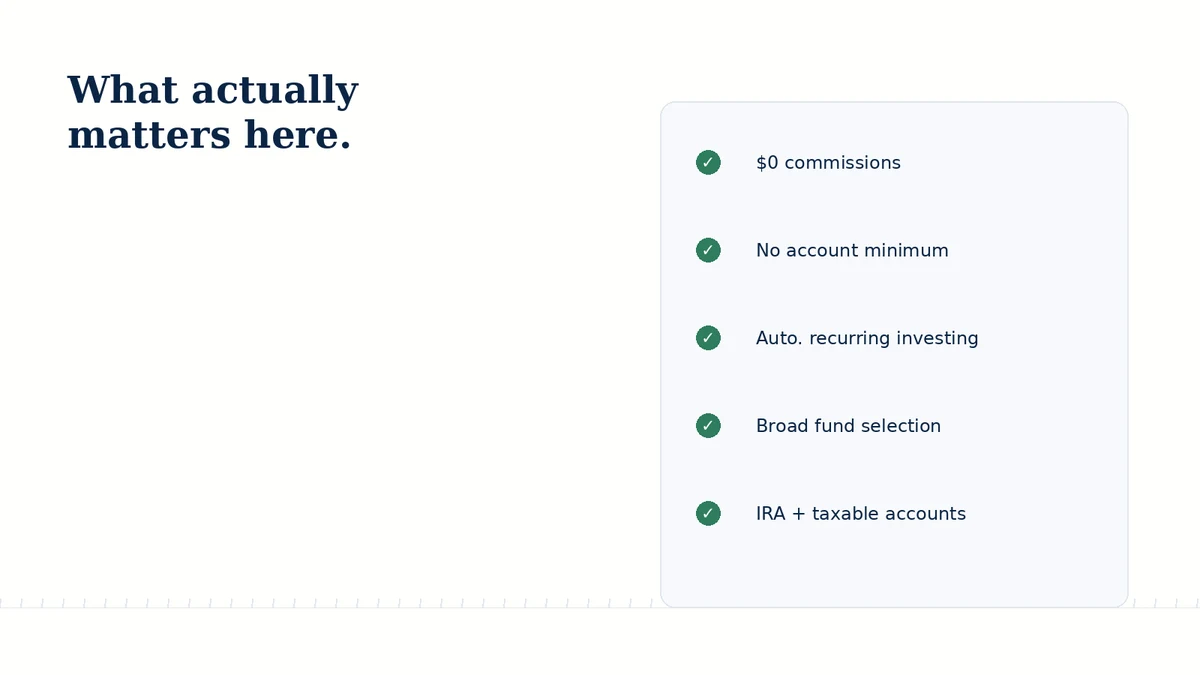
Choosing a brokerage for long-term index investing is a lower-stakes decision than it can feel like — the major low-cost providers have converged on broadly similar core offerings (commission-free stock and ETF trades, no account minimums for most account types, wide fund selection). The decision usually comes down to a smaller set of genuine differentiators, which this guide walks through directly rather than declaring a single universal winner.
What actually matters for a long-term index investor
It's worth separating features that matter a great deal for active traders from those that matter for a long-term index investor making periodic purchases, since brokerage comparison content often emphasizes the former:
| Matters a lot for index investors | Matters less for index investors |
|---|---|
| $0 commissions on ETF/stock trades | Advanced charting and technical analysis tools |
| No or low account minimums | Options trading features |
| Automatic recurring investment support | Real-time Level 2 market data |
| Availability of low-cost index funds/ETFs | Margin trading rates |
| Account types offered (IRA, Roth IRA, taxable, 401(k) rollover) | Social/community trading features |
Commission-free trading is now close to standard
Commission-free trading on stocks and ETFs has become widely available across major U.S. online brokerages, which has meaningfully reduced the cost differentiation between them for buy-and-hold investors specifically — a cost that used to matter a great deal (per-trade commissions) now matters much less, since it applies to essentially every mainstream provider. This is genuinely good news for long-term index investors: it means the brokerage-choice decision can focus more on fund selection, account features, and usability than on trading costs, which was not always true historically. See Fidelity vs. Vanguard vs. Schwab for a direct look at how three of the largest low-cost providers actually differ.
Fund selection and proprietary fund families
Most major brokerages allow you to buy virtually any publicly traded ETF, including funds from competing providers, regardless of which brokerage you use — this is generally true for ETFs specifically. Traditional index mutual funds, however, sometimes come with additional considerations: some brokerages charge a transaction fee to buy a competitor's proprietary mutual fund (as opposed to their own), or don't offer certain fund families' mutual funds at all. If you have a strong preference for a specific provider's traditional mutual fund share class (as opposed to the ETF equivalent), it's worth confirming your chosen brokerage offers it without an added fee before opening the account.
Account types to look for
Confirm your prospective brokerage offers the specific account type(s) you need: Traditional IRA, Roth IRA, and taxable brokerage accounts are widely available across nearly all major providers; a Simplified Employee Pension (SEP) IRA or Solo 401(k) for self-employed income is offered by many but not universally; and 401(k) rollover support (helping you move an old employer plan into an IRA) is a feature worth confirming if you anticipate needing it. Most major providers support the common account types a typical individual investor needs; it's the less common ones worth double-checking.
Automatic investing features
Since consistent, automated contributions are one of the highest-leverage habits in long-term investing (see Dollar-Cost Averaging Explained), confirm your brokerage supports scheduling recurring automatic purchases into a specific fund on a set schedule — most major providers do, but the specific implementation (which funds qualify, minimum amounts, scheduling flexibility) varies somewhat and is worth checking directly in each provider's help documentation.
Usability and account transfer considerations
A platform's interface, mobile app quality, and customer support responsiveness are more subjective than the factors above, but they matter in practice — a brokerage you find confusing or unpleasant to use is one you're less likely to interact with consistently, including checking in periodically and maintaining your automatic contributions. It's also worth understanding your provider's account transfer process before you need it: moving an account between brokerages (an "ACATS transfer") is generally possible and often free to initiate, but confirming this in advance avoids an unpleasant surprise later if you decide to switch.
Common mistakes
- Choosing a brokerage based on trading features you won't use. Advanced tools built for active traders add little value for a buy-and-hold index strategy.
- Not confirming account type availability before opening an account. Confirm your specific needed account type is supported first.
- Overweighting brand familiarity over actual fee and fund-selection comparison. A less familiar name may offer identical or better terms for your specific needs.
- Ignoring whether automatic recurring investing is supported. This feature matters more for long-term consistency than most trading-focused features.
Frequently Asked Questions
Do I need a different brokerage for a 401(k) vs. an IRA?
Your 401(k) provider is typically chosen by your employer, not you — you generally can't move it to a different brokerage while employed there, though you can often roll it into an IRA at a brokerage of your choice after leaving the employer.
Is it safe to keep my investments at an online brokerage?
Most legitimate U.S. brokerages are members of SIPC, which provides limited protection for securities in the event the brokerage itself fails — this protects against brokerage failure, not against normal investment losses from market movements. Verify SIPC membership directly with any provider you're considering.
Can I have accounts at more than one brokerage?
Yes, and some investors do this deliberately, though it can add complexity to tracking your overall portfolio and rebalancing across accounts.
Does the 'best' brokerage change over time?
The competitive landscape does shift as providers adjust fees and features, which is part of why this guide focuses on evaluation criteria you can reapply, rather than a single fixed recommendation.
Where to invest
The providers below are commonly used for index investing. Always compare current fees and account terms directly with each provider before opening an account.
No affiliate relationships are currently active on this page. If that changes, any compensation WealthGuides receives from a provider link will be disclosed here, and it will never affect which providers we cover or how we describe them — see our editorial policy.
Summary
For long-term index investing specifically, the features that matter most are: no-cost trading on the funds you actually plan to buy, account types matching your goals (IRA, taxable, etc.), a reasonable selection of low-cost index funds or ETFs, and a platform you find usable enough to stick with consistently. Beyond that baseline, differences between major low-cost brokerages tend to matter less for a buy-and-hold index investor than they might for an active trader — consistency in contributing matters more than which specific low-cost brokerage you choose.
This article is educational only and not personalized investment advice. See our full disclaimer.
Sources & References
- SEC — Investor.gov: Working with Investment Professionals
- Securities Investor Protection Corporation (SIPC)
Corrections & updates: No corrections logged since publication. Note: specific commission and fee structures change periodically across the brokerage industry — always verify current terms directly with a provider before opening an account.