
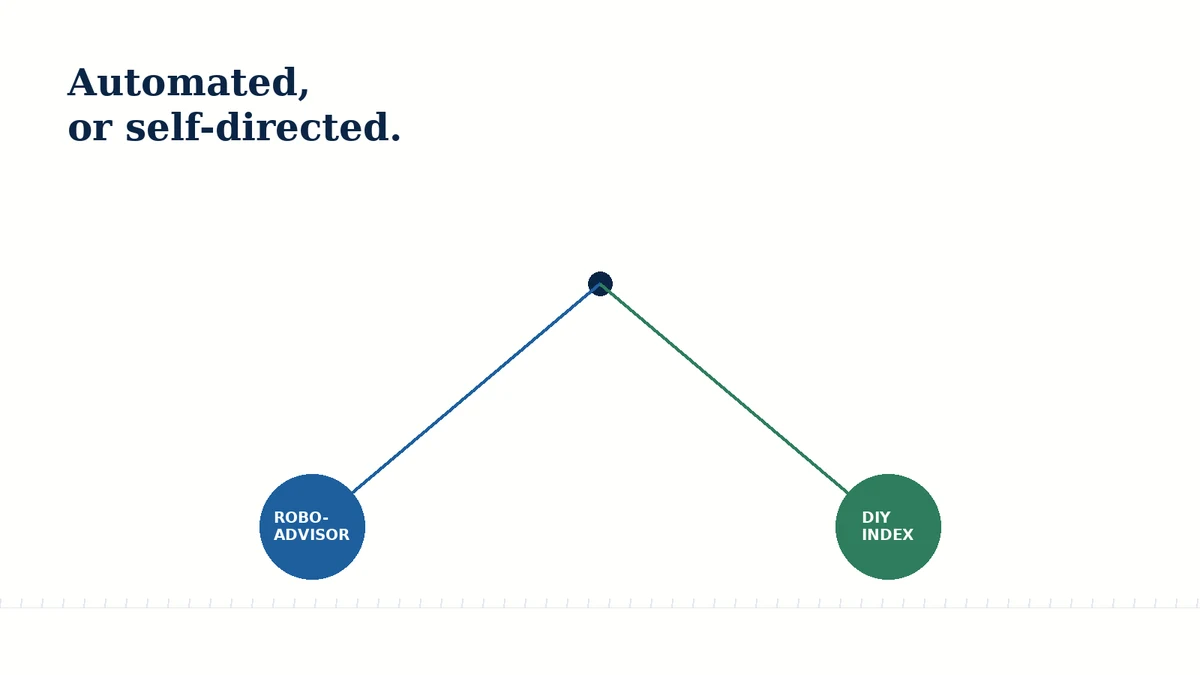
A robo-advisor builds and manages a diversified portfolio for you — typically composed of low-cost index funds — based on your answers to a risk-tolerance questionnaire, and automatically rebalances it over time, for an additional management fee on top of the underlying funds' own expense ratios. The question isn't whether robo-advisors are "good" or "bad" — they're built on the same index fund logic covered throughout this site — but whether the added fee is worth the convenience for your specific situation.
What a robo-advisor actually does
Most robo-advisors follow a similar model: you complete a questionnaire about your goals, time horizon, and risk tolerance; the platform recommends (and implements) a diversified portfolio, typically built from a small set of low-cost index ETFs across stocks, bonds, and sometimes other asset classes; and the platform automatically rebalances the portfolio over time and, in some cases, offers automated tax-loss harvesting in taxable accounts. You're not selecting individual funds yourself — the platform handles fund selection and adjustment according to its own methodology.
The core tradeoff: cost vs. convenience
Robo-advisors typically charge an additional annual management fee — commonly in a range of roughly 0.25% to 0.50% of assets, though this varies by provider — on top of the expense ratios of the underlying index funds the robo-advisor invests in. A DIY investor building the equivalent portfolio directly (buying the same or similar underlying index funds themselves) avoids this added layer of fees entirely, paying only the funds' own expense ratios.
Whether that added fee is worth it depends entirely on how much value you place on the automation, guardrails, and time savings — for some investors, the fee is a reasonable price for not having to make allocation and rebalancing decisions themselves; for others who are comfortable managing a small number of funds directly, it's an avoidable cost for something they could do themselves in a few minutes per year.
What DIY index investing actually requires
Managing your own index fund portfolio directly is less complicated than it might sound, precisely because index investing is designed to minimize ongoing decisions. In practice it typically involves: choosing a small number of broad, low-cost funds (see Building a 3-Fund Portfolio), setting up automatic recurring contributions, and checking in roughly once a year to confirm your allocation hasn't drifted meaningfully from your target and rebalancing if it has (see Rebalancing Your Portfolio). This is genuinely a small amount of ongoing effort for many investors, once the initial setup is complete — but it does require some willingness to learn the basics and follow through consistently without automated hand-holding.
Where robo-advisors offer more genuine value
The case for a robo-advisor tends to be strongest for investors who know they're unlikely to rebalance consistently on their own, who want automated tax-loss harvesting without managing it manually, or who simply prefer not to make investment decisions at all and value having a structured system handle it, even at a modest added cost. It can also lower the research burden for a complete beginner who isn't yet comfortable selecting funds directly. None of these are wrong reasons — for some people, a small added fee in exchange for consistent execution is a good trade, particularly if the alternative is inconsistent DIY management or, worse, not investing at all due to feeling overwhelmed by the choices involved. It's worth knowing there's also a lower-cost hands-off option worth comparing before paying a robo-advisor's management fee: a single target-date fund held directly, which automates diversification and rebalancing without an added advisory layer, though with less personalization than a robo-advisor's questionnaire-based approach — see 3-Fund Portfolio vs. Target-Date Fund for how that specific tradeoff compares against building the allocation yourself.
A middle path: using a robo-advisor's approach as a template
Some investors use a robo-advisor's suggested allocation as a reference point, then implement a very similar portfolio manually through a standard brokerage account (see Fidelity vs. Vanguard vs. Schwab for a comparison of providers), avoiding the added management fee while still benefiting from a professionally designed starting allocation. This requires more initial effort than either the pure robo-advisor or pure DIY approaches, but can combine some of the cost savings of DIY investing with some of the structure of a robo-advisor's recommendation.
Common mistakes
- Not comparing the robo-advisor's total fee (management fee plus underlying fund expense ratios) against a comparable DIY portfolio. The added cost is only meaningful in context.
- Assuming DIY investing requires constant attention. A well-constructed index portfolio needs infrequent check-ins, not daily management.
- Choosing a robo-advisor for features you won't use. If you don't need automated tax-loss harvesting or won't hold a taxable account, some of the added value may not apply to you.
- Switching strategies frequently. Both approaches work best with consistency; frequently switching between robo-advisor and DIY (or between different DIY allocations) tends to undermine the benefits of either.
Frequently Asked Questions
Are robo-advisor portfolios made of index funds?
Typically yes — most robo-advisors build portfolios primarily from low-cost index ETFs, applying their own allocation methodology on top.
Is a robo-advisor safer than managing my own investments?
Not in terms of market risk — a robo-advisor portfolio is still subject to normal market fluctuations. It may reduce certain behavioral risks, like failing to rebalance, but it doesn't eliminate investment risk.
Can I switch from a robo-advisor to DIY investing later?
Generally yes, though selling existing holdings to restructure a portfolio can trigger taxable events in a taxable account — consider consulting a tax professional before making a large restructuring.
Do robo-advisors offer retirement accounts?
Most major robo-advisor platforms offer Traditional and Roth IRA accounts in addition to taxable accounts; specific offerings vary by provider.
Where to invest
Compare current management fees and underlying fund expense ratios directly with any specific provider before deciding.
No affiliate relationships are currently active on this page. If that changes, any compensation WealthGuides receives from a provider link will be disclosed here, and it will never affect which providers we cover or how we describe them — see our editorial policy.
Summary
A robo-advisor automates portfolio construction, rebalancing, and sometimes tax-loss harvesting, for an added annual fee on top of the underlying index funds it uses. A DIY approach — buying and managing your own small set of index funds directly — avoids that added fee but requires you to make and stick to your own allocation and rebalancing decisions. Neither is objectively superior; the choice depends on how much you value the convenience and behavioral guardrails of automation versus the lower cost and full control of managing it yourself.
This article is educational only and not personalized investment advice. See our full disclaimer.
Sources & References
Corrections & updates: No corrections logged since publication.