
A Health Savings Account is technically a medical spending account, not a retirement account — but its tax treatment is unusual enough that some investors deliberately use it as one of the most tax-efficient long-term investment vehicles available, ahead of a Roth or Traditional IRA in some comparisons. This only works under specific conditions, and it requires understanding rules that have nothing to do with retirement accounts elsewhere on this site. This guide covers the mechanism, the eligibility requirements, and where it fits alongside the accounts covered in Traditional vs. Roth IRA for Index Investors.
The triple tax advantage, precisely
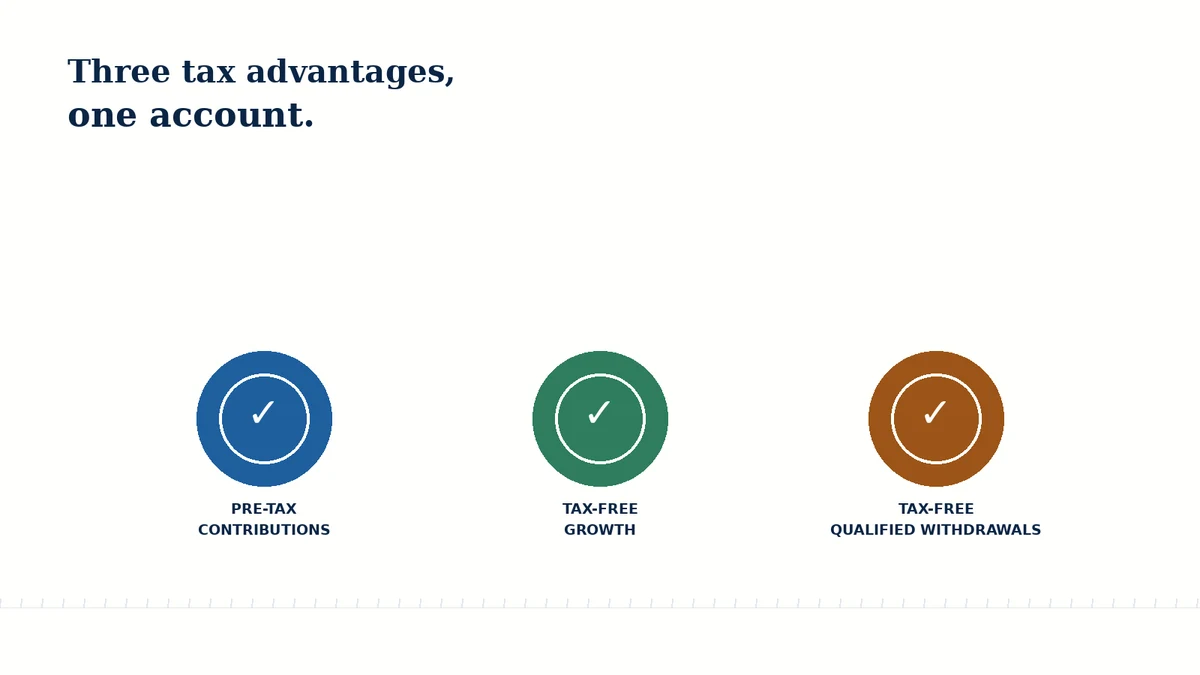
Most tax-advantaged accounts give you one or two of three possible tax benefits: a deduction on contributions, tax-deferred or tax-free growth, and tax-free withdrawals. A Traditional IRA gives you the first two; a Roth IRA gives you the second two. An HSA is structured to give you all three simultaneously: contributions are made pre-tax (or are tax-deductible if made outside payroll), the account's investments grow without any annual tax on dividends or capital gains, and withdrawals are entirely tax-free provided they're used for qualified medical expenses — at any point, not just in retirement.
This structure exists because an HSA is legally a medical account, not a retirement account, and Congress designed it to encourage saving for healthcare costs specifically. The retirement-investing strategy built on top of it is something investors and financial educators developed by recognizing what the underlying tax rules actually allow, not a feature the account was originally marketed around.
Who can actually contribute to an HSA
Eligibility is the first real constraint, and it's stricter than for an IRA: to contribute to an HSA, you must be enrolled in an IRS-qualifying high-deductible health plan (HDHP), have no other disqualifying health coverage, and not be enrolled in Medicare. If you don't have an HDHP, you can't open or contribute to an HSA at all, regardless of income or any other factor — this is a meaningfully different eligibility structure than IRAs, which are available to anyone with earned income (subject to the income limits covered in other account-specific articles on this site).
Annual HSA contribution limits are set by the IRS and adjusted periodically, with a separate, lower limit for self-only coverage versus family coverage, plus an additional catch-up contribution allowed after age 55. These figures change most years — always verify the current limit directly at IRS Publication 969 before contributing, rather than relying on a number from this or any other article.
How the retirement-investing strategy actually works
The strategy has a specific mechanic: instead of using HSA funds to pay medical bills as they occur, you pay those bills out of pocket (from a taxable savings or checking account) and leave the HSA balance invested — typically in the same kind of low-cost index funds covered throughout this site, if your HSA provider offers them. Because HSA funds don't expire and aren't "use it or lose it" like some other medical spending accounts, the balance can compound for decades, the same way an IRA balance does.
The reimbursement rule is what makes this work as a long-term strategy: the IRS allows you to reimburse yourself for a qualified medical expense at any time after the expense occurred, with no deadline, as long as you kept the receipt and the HSA was already open when the expense occurred. This means an investor can accumulate medical receipts over decades, let the HSA investments grow tax-free the entire time, and then withdraw a lump sum tax-free in retirement by reimbursing years of accumulated, previously unclaimed medical expenses — while the invested balance kept compounding the whole time it wasn't withdrawn.
What happens after age 65
At age 65, the HSA's rules change in a way that adds flexibility: withdrawals for qualified medical expenses remain entirely tax-free, exactly as before, but withdrawals for non-medical purposes are also now permitted — taxed as ordinary income, with no additional penalty. This makes the account behave very similarly to a Traditional IRA after 65 for non-medical withdrawals, while retaining the tax-free treatment for medical withdrawals specifically. Before 65, a non-medical withdrawal is both taxed as income and hit with an additional 20% penalty — a meaningful difference worth understanding before assuming HSA funds are freely accessible for any purpose.
How this compares to prioritizing an IRA or 401(k)
Given the same dollar contributed, an HSA's tax treatment is arguably more favorable than either a Traditional or Roth IRA for money that will eventually cover medical expenses, since it avoids tax at both the contribution and withdrawal stages for that specific use — something neither IRA type achieves simultaneously. For money that might not end up covering medical expenses, an HSA used past 65 behaves similarly to a Traditional IRA, making it a reasonable, not clearly superior, alternative. A commonly cited prioritization order among investors pursuing this strategy: capture any employer 401(k) match first (see 401(k) Index Fund Options Explained), then max out HSA contributions if eligible, then continue with IRA or additional 401(k) contributions — though this ordering depends on individual circumstances and isn't a universal rule.
The real constraint: paying medical costs out of pocket
This entire strategy depends on being able to afford current medical expenses without touching the HSA balance, which isn't realistic for every household, particularly given that HDHPs by definition carry higher deductibles than many alternative health plans. An investor without meaningful savings margin may reasonably need to use HSA funds for actual medical costs as they occur — which is still a legitimate, tax-advantaged way to pay for healthcare, just not the long-term compounding strategy described above. Whether the investing strategy is realistic depends entirely on your actual financial cushion, not just your enthusiasm for the tax mechanics.
Choosing HSA investments
Not all HSA providers offer investment options — some function purely as a spending account with no ability to invest the balance in funds at all, or require a minimum cash balance before allowing anything above it to be invested. Where investment options exist, the same evaluation principles from Best Index Funds for Beginners apply directly: check the available funds' expense ratios, confirm what each one tracks, and prefer low-cost, broadly diversified options over the HSA provider's proprietary or higher-fee choices where a comparable low-cost alternative exists.
Frequently Asked Questions
Can I have an HSA and a 401(k) at the same time?
Yes — an HSA and a 401(k) are independent accounts with separate eligibility rules and contribution limits; many investors contribute to both.
What happens to my HSA if I switch to a health plan that isn't a qualifying HDHP?
You can no longer contribute to the HSA, but the existing balance remains yours, keeps growing tax-free if invested, and can still be used for qualified medical expenses at any time.
Do I have to submit medical receipts to the IRS?
Not proactively, but you're required to keep records supporting any reimbursement in case of an audit — the IRS does not require submitting receipts at the time of contribution or investment.
Is HSA money ever "use it or lose it" like a Flexible Spending Account?
No — this is a key difference from FSAs. HSA balances roll over indefinitely and are never forfeited, which is part of what makes the long-term investing strategy possible.
Summary
An HSA offers a genuinely unusual tax structure: pre-tax contributions, tax-free investment growth, and tax-free withdrawals for qualified medical expenses — with no equivalent restriction at any other point. Investors who can afford to pay current medical costs out of pocket, and who leave HSA contributions invested rather than spent, can use the account as a long-term, triple-tax-advantaged investment vehicle. This requires a qualifying high-deductible health plan and a specific spending discipline; it isn't automatically available or automatically the right strategy for everyone.
This article is educational only and not personalized investment advice. See our full disclaimer.
Sources & References
- IRS Publication 969 — Health Savings Accounts and Other Tax-Favored Health Plans
- IRS.gov — HSA, FSA and HRA Basics
Corrections & updates: No corrections logged since publication.