
A 401(k) plan's fund menu is chosen by your employer (with guidance from a plan administrator), not by you individually — which means your fund choices are limited to whatever the plan actually offers, unlike an IRA where nearly any publicly traded fund is available. Understanding how to evaluate the specific options in front of you is the practical skill this guide focuses on.
Why 401(k) fees can differ from IRA fees for the 'same' fund
A 401(k) plan often layers a plan administration fee on top of the underlying funds' own expense ratios, to cover the cost of running the plan itself (recordkeeping, compliance, and the plan provider's services). This means even if your 401(k) offers what's essentially the same index fund available in an IRA, your effective cost inside the 401(k) can be somewhat higher once plan-level fees are included. This isn't true of every plan — some large employer plans negotiate very competitive institutional pricing — but it's worth checking your specific plan's fee disclosure document (employers are required to provide one) rather than assuming your 401(k)'s costs match what you'd see shopping directly for the same fund in an IRA.
Common 401(k) fund menu categories
| Category | What it typically offers |
|---|---|
| Target-date funds | A single fund that automatically adjusts its stock/bond mix over time toward a target retirement year |
| Index funds | Funds tracking a specific benchmark (S&P 500, total market, international, bond index), usually lower-cost than actively managed options in the same plan |
| Actively managed funds | Manager-selected funds, typically with higher expense ratios than the plan's index options |
| Company stock (if offered) | Shares of your employer's own stock — concentrates risk in a single company, including the same company your income already depends on |
Evaluating your specific plan's index options
Within whatever index funds your plan offers, the same evaluation approach from Best Index Funds for Beginners applies: check the expense ratio of each option (including any plan-level fee, disclosed separately in your plan documents), confirm what index each fund actually tracks, and choose the lowest-cost option(s) that together give you the diversification and allocation you want. If your plan offers both an S&P 500 index fund and a total U.S. market index fund, for instance, either is a reasonable core holding — the choice mostly comes down to whether you want small and mid-cap exposure included, as discussed in S&P 500 Index Funds Explained.
Target-date funds: convenience with a specific cost tradeoff
A target-date fund automatically holds a diversified mix of stocks and bonds that shifts toward more conservative allocations as the target year (often aligned with an expected retirement year) approaches, handling both diversification and rebalancing without requiring you to manage it. This convenience typically comes at a somewhat higher expense ratio than building the equivalent allocation yourself from the plan's individual index fund options — worth weighing against how much you value not managing the allocation and rebalancing yourself. For many 401(k) participants who don't want to actively manage their allocation, a target-date fund remains a reasonable default; for those willing to do a small amount of additional work, manually combining lower-cost individual index funds can reduce costs somewhat, at the expense of needing to rebalance periodically yourself.
Capturing the employer match first
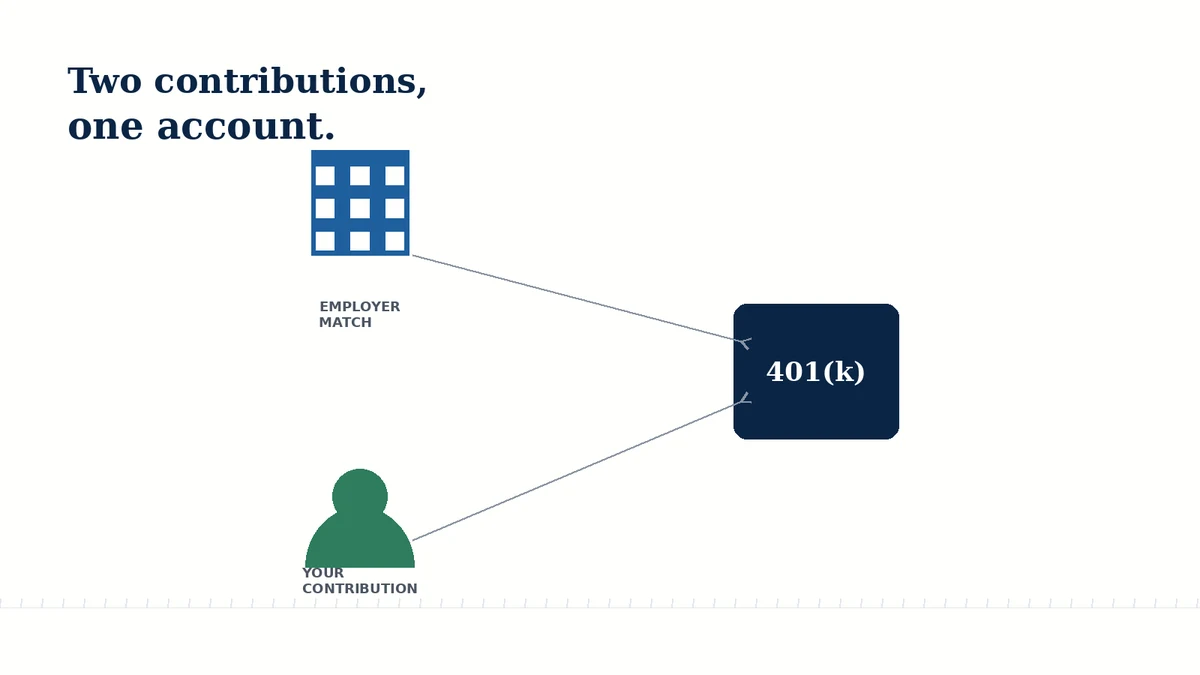
Before optimizing which specific fund to choose, confirm you're contributing enough to capture any full employer match your plan offers — this is effectively an immediate, guaranteed additional return on that portion of your contribution that no fund selection decision can match. If your plan offers a match, prioritize contributing at least enough to capture it in full before directing additional retirement savings elsewhere (such as an IRA, or — for those with an eligible high-deductible health plan — an HSA used as a retirement account), a point covered further in How to Buy Your First Index Fund.
What to do if your plan's options are genuinely poor
Some 401(k) plans, particularly at smaller employers, offer a limited menu with relatively high fees across the board and no clearly low-cost broad index option. In that situation, a reasonable approach is still capturing any employer match (since that immediate return typically outweighs the fee drag), while choosing the least expensive, most broadly diversified option available among the plan's choices, and directing additional retirement savings beyond the match amount toward an IRA, where you'll typically have access to a much wider, lower-cost fund selection. This isn't a failure on your part — plan quality varies significantly by employer, and working within a suboptimal plan's constraints while maximizing the match is a reasonable response to that constraint.
Common mistakes
- Not reading the plan's fee disclosure document. This is where actual fund and plan-level fees are disclosed — it's required to be provided but often goes unread.
- Leaving contributions in a plan's default option without reviewing it. Many plans default new participants into a target-date fund based on estimated retirement age, which may or may not match your actual goals or risk tolerance.
- Not capturing the full employer match before contributing elsewhere. This is typically the single highest-return action available in retirement planning.
- Over-concentrating in employer company stock. This ties your investment portfolio's fate to the same employer your income already depends on — a form of concentrated risk many financial educators caution against.
Frequently Asked Questions
Are 401(k) index funds always more expensive than IRA index funds?
Not always — some large employer plans negotiate very competitive institutional pricing, sometimes even lower than retail IRA pricing. It varies significantly by plan, which is why checking your specific plan's fee disclosure directly matters.
Should I roll over an old 401(k) into an IRA?
This is commonly done after leaving an employer, often to access a broader, potentially lower-cost fund selection — but specific plan fees and features vary, so compare your old plan's costs against IRA alternatives before deciding, and consider consulting a financial professional.
What if my 401(k) doesn't offer any index funds?
This is less common today than in the past, but some smaller plans have limited menus. In that case, choose the lowest-cost, most broadly diversified option available, capture any match, and consider directing additional savings to an IRA.
Is company stock in my 401(k) a bad idea?
It concentrates risk in a single company that your employment income already depends on, which many financial educators caution against holding in large proportions, though a modest allocation some plans offer as a match component is a different, more limited consideration.
Summary
A 401(k) plan menu typically includes some mix of index funds, actively managed funds, and target-date funds, often with fees that can be somewhat higher than what's available directly in an IRA, due to plan administration costs layered on top of fund expenses. The practical approach is comparing the actual expense ratios of your plan's specific fund options (available in your plan's fee disclosure document), prioritizing the lowest-cost fund(s) that provide the broad diversification you want, and capturing any full employer match before optimizing further.
This article is educational only and not personalized investment advice. See our full disclaimer.
Sources & References
Corrections & updates: No corrections logged since publication.