
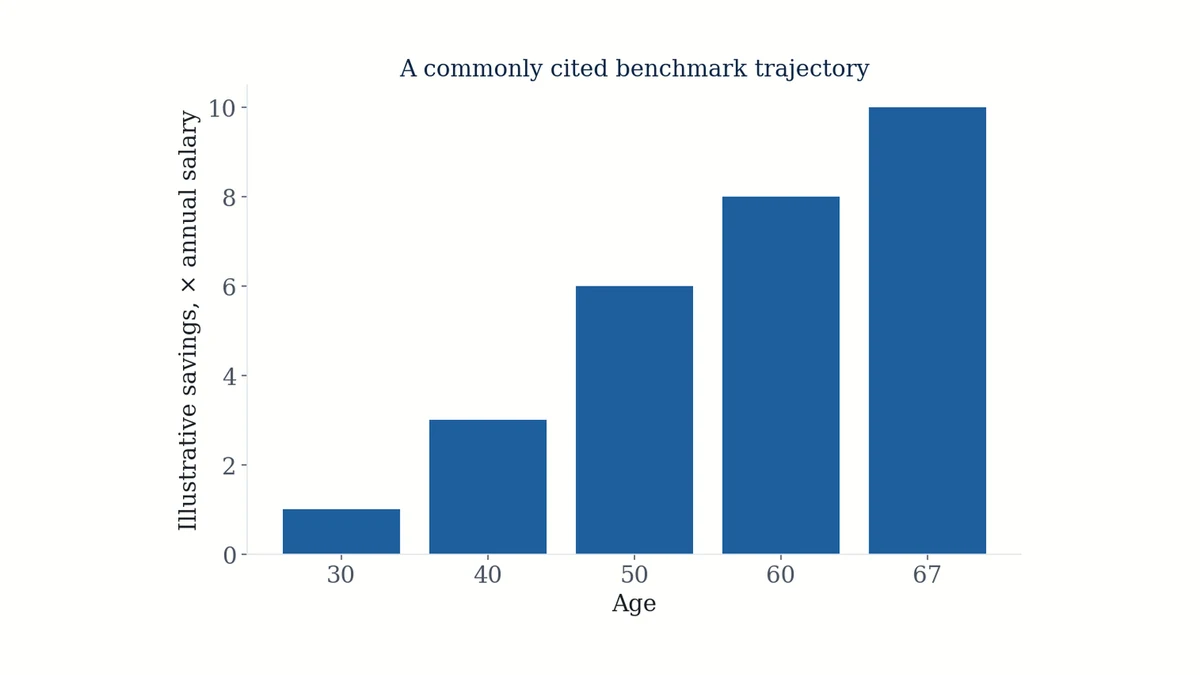
"Am I saving enough?" is one of the most common questions in personal finance, and it doesn't have a single universal answer — it depends on your income, expected retirement age, expected expenses, and other income sources like Social Security. That said, several widely cited benchmark frameworks offer a useful reality check. This guide covers the most common ones, where they come from, and how to use them appropriately.
Common savings benchmarks by age
| Age | Commonly cited savings target |
|---|---|
| 30 | ≈1× annual salary |
| 40 | ≈3× annual salary |
| 50 | ≈6× annual salary |
| 60 | ≈8× annual salary |
| 67 (common full retirement age) | ≈10× annual salary |
These specific figures originate from retirement research published by major financial services firms, generally built on assumptions about a target retirement age (often around 65–67), an assumed retirement length, expected investment returns, and Social Security supplementing (not replacing) savings. They're population-level guidelines, not calculated for your individual circumstances — someone planning to retire earlier, with more expensive planned retirement expenses, or without another income source like a pension would reasonably need to save more relative to these benchmarks; someone with lower expected expenses or other income sources might reasonably need less.
A more personalized approach: the savings rate method
An alternative to age-based net-worth benchmarks is targeting a consistent savings rate — commonly cited guidance suggests saving somewhere in the range of 10% to 15% of income for retirement, starting as early as possible, though this range is itself a general guideline rather than a precise formula, and someone starting later or targeting an earlier retirement would generally need a higher rate to reach a comparable outcome. The core idea behind the savings-rate approach is that starting early and contributing consistently matters more than hitting a precise net-worth number at any specific age, since compounding does much of the work over a long enough horizon.
A worked example: modeling your own trajectory
Rather than relying solely on population benchmarks, you can project your own trajectory using our retirement savings calculator: enter your current age, current savings, monthly contribution, and an assumed return rate to see a projected balance at your target retirement age. For example, a 30-year-old with $20,000 saved, contributing $500 monthly at an assumed 7% average annual return, would project to roughly $1,130,600 by age 65 — illustrating how starting amount, contribution rate, and time horizon interact, and giving you a personal figure to compare against your own retirement income goals, rather than relying purely on an age-based multiple of salary that may not reflect your specific situation. Of that total, only $230,000 comes from actual contributions ($20,000 starting plus $500 a month for 35 years) — the remaining roughly $900,600 is projected investment growth, which is the part of the calculation that depends entirely on an assumed return rate nobody can guarantee in advance.
What these benchmarks don't account for
Standard age-based benchmarks typically don't account for: your specific planned retirement age (earlier retirement requires more savings, all else equal); the cost of living in your specific planned retirement location; whether you'll have a pension or other guaranteed income beyond Social Security; your health and expected healthcare costs in retirement, which some investors address partly through an HSA used as a retirement account; and how conservatively or aggressively you plan to spend down savings in retirement — including the timing risk covered in Sequence of Returns Risk. This is why the benchmarks are best used as a rough sanity check — "am I dramatically behind a typical trajectory, or roughly in line with one" — rather than as a precise personal target.
What to do if you're behind a common benchmark
Being behind a population-level benchmark isn't a crisis in itself — many people are, for entirely reasonable circumstances (career changes, education costs, supporting family members, health events). Practical, commonly cited responses include: increasing your savings rate incrementally over time (for instance, directing a portion of each future raise toward retirement savings rather than only toward spending), maximizing any available employer match before it's left unclaimed, considering a modestly later retirement age if feasible, and reviewing your expected retirement expenses realistically rather than assuming a specific benchmark number is a fixed requirement. None of this is personalized financial advice — a financial planner can help translate these general options into a plan specific to your situation.
Common mistakes
- Treating a population benchmark as a precise personal requirement. These are general reference points; your appropriate target depends on your specific goals and circumstances.
- Panicking over being "behind" without modeling your own actual trajectory. Running your own numbers, as illustrated above, often provides more useful, actionable information than comparing to an age-based multiple alone.
- Ignoring the impact of starting later. Starting later is a real, meaningful factor — but it argues for increasing your savings rate going forward, not for giving up on the goal.
- Forgetting other income sources in retirement. Social Security and any pension income should factor into your total retirement income picture, not just your savings balance in isolation.
Frequently Asked Questions
Where do these age-based savings benchmarks come from?
They typically originate from retirement research published by major financial services firms, based on assumptions about typical retirement age, expected investment returns, and reliance on Social Security as a supplement — not from a government-mandated standard.
Is 15% of income enough to save for retirement?
It's a commonly cited general guideline for someone starting relatively early, but the appropriate rate for your situation depends on your current age, target retirement age, and expected expenses — modeling your own numbers gives a more personalized answer than a single percentage.
Does this include my employer's 401(k) match?
Most savings-rate guidelines commonly include employer matching contributions as part of the total percentage, though it's worth checking a specific source's exact methodology, since conventions vary.
Should I include home equity in these calculations?
Most standard retirement savings benchmarks focus specifically on retirement investment accounts, not total net worth including home equity, since home equity isn't typically a liquid source of retirement income in the same way.
Summary
Commonly cited retirement savings benchmarks suggest accumulating roughly one times your annual salary by age 30, three times by 40, six times by 50, and eight to ten times by retirement age — figures that originate from major financial institutions' retirement research, not a government standard. These are population-level averages meant as a general reality check, not personalized targets; your own appropriate savings rate depends on your specific expected retirement age, expenses, and other income sources.
This article is educational only and not personalized investment advice. See our full disclaimer.
Sources & References
- Social Security Administration — Retirement Benefits
- Bureau of Labor Statistics — Consumer Expenditure Survey
Corrections & updates: No corrections logged since publication.