
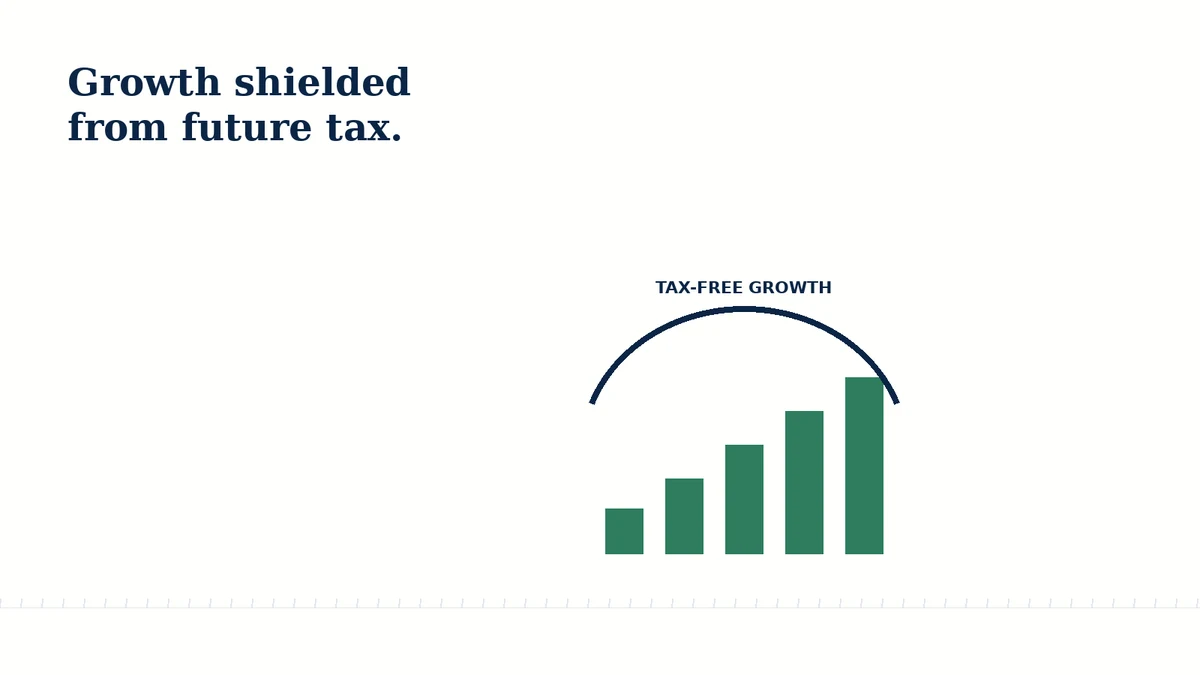
Yes — a Roth IRA can hold index funds, and for many long-term investors it's one of the more natural pairings available. A Roth IRA is a retirement account funded with after-tax dollars, where qualified withdrawals in retirement are entirely tax-free — including all the investment growth that happened along the way. Combined with index funds, this creates a specific and genuinely powerful combination: decades of compounding growth on assets that, if the rules are followed, will never be taxed again. This guide covers how the account actually works, current contribution rules, and how to think about fund selection within it.
How a Roth IRA's tax treatment actually works
You contribute money to a Roth IRA that has already been taxed as ordinary income — there's no upfront tax deduction, unlike a Traditional IRA. In exchange, qualified withdrawals in retirement (generally after age 59½ and once the account has been open at least five years) are entirely free of federal income tax, including all investment growth that occurred inside the account over however many years or decades it was invested. This means every dollar of dividend income, capital gains, and price appreciation your index funds generate inside the account is never taxed, provided you follow the qualified-withdrawal rules — a meaningfully different outcome than the same investment growth occurring in a taxable brokerage account, where it would be taxed along the way.
Current contribution rules — verify directly with the IRS
The IRS sets an annual contribution limit for IRAs (combined across Traditional and Roth IRAs if you have both), along with income-based eligibility limits that determine whether, and how much, you can contribute directly to a Roth IRA based on your modified adjusted gross income and tax filing status. These figures are adjusted periodically and should always be verified directly at IRS.gov's IRA contribution limits page before contributing, rather than relying on a figure from this or any other article, which may be out of date by the time you read it.
What if my income is too high to contribute directly?
Higher earners whose income exceeds the direct Roth IRA contribution eligibility limits sometimes use a strategy commonly referred to as a "backdoor Roth IRA" — contributing to a Traditional IRA (which generally has no income limit for the contribution itself, though the deductibility of that contribution may be limited) and then converting it to a Roth IRA. This strategy involves specific tax rules and potential complications (particularly if you hold other pre-tax Traditional IRA balances), and it's worth researching carefully or consulting a tax professional before attempting it, since executing it incorrectly can create unexpected tax consequences.
Choosing index funds within a Roth IRA
Because a Roth IRA's tax-free growth already eliminates ongoing dividend and capital-gains taxation, some of the ETF-specific tax-efficiency advantages discussed in What Is an ETF? matter less here than they would in a taxable account — an index mutual fund and an index ETF tracking the same benchmark will generally produce a very similar after-tax (in this case, tax-free) outcome inside a Roth IRA. This means fund selection can focus more purely on expense ratio, index scope, and available fund selection within your specific Roth IRA provider, without needing to weigh taxable-account-specific tax efficiency as heavily.
A broad, diversified approach — such as the three-fund framework covered in Building a 3-Fund Portfolio — is a common and reasonable way to structure a Roth IRA's holdings, adjusted to your personal time horizon and risk tolerance per Asset Allocation by Age. For the practical mechanics of actually opening the account and placing the order once you've decided on a fund, see How to Buy Your First Index Fund.
Why a Roth IRA often suits younger or lower-income-bracket investors well
A commonly cited rationale for prioritizing a Roth IRA is that paying tax on contributions now, while in a relatively lower tax bracket (common earlier in a career), can be more favorable than deferring the tax to retirement withdrawals under a Traditional IRA, if you expect to be in a similar or higher tax bracket later. This isn't universally true for every individual's situation — it depends on your specific current and expected future tax brackets, which are impossible to know with certainty in advance — but it's a commonly cited reason younger investors, or those in relatively lower current tax brackets, often lean toward Roth contributions. This tradeoff is covered in full detail, with a worked comparison, in Traditional vs. Roth IRA for Index Investors.
Withdrawal rules worth knowing
Roth IRA contributions (though generally not the investment earnings on those contributions) can typically be withdrawn at any time without tax or penalty, since they were already taxed before being contributed — a flexibility Traditional IRAs and 401(k)s don't share in the same way. Earnings, however, are generally subject to tax and potentially a penalty if withdrawn before age 59½ and before the account has been open five years, with some exceptions (such as a qualifying first-time home purchase, up to certain limits). This flexibility around contribution withdrawals is sometimes cited as an advantage, though relying on it defeats the account's core purpose of long-term tax-free retirement growth — verify current rules directly at IRS.gov before making any withdrawal decision.
Common mistakes
- Contributing more than the annual limit. Excess contributions can trigger a penalty tax if not corrected in time — verify the current limit before contributing.
- Not checking income eligibility before contributing directly. High earners may need to use a backdoor Roth strategy instead of a direct contribution.
- Withdrawing earnings early without understanding the tax and penalty consequences. Contribution withdrawals and earnings withdrawals are treated differently.
- Holding overly conservative investments given the account's long tax-free growth horizon. A Roth IRA's tax-free compounding benefit is largest over long horizons, which argues for a genuinely growth-oriented allocation for younger investors specifically.
Frequently Asked Questions
Can I have both a Roth IRA and a 401(k)?
Yes — they're separate account types with separate contribution limits, and many investors use both.
What happens if I contribute to a Roth IRA but my income was too high that year?
This creates an excess contribution subject to IRS penalty rules unless corrected by a specific deadline — consult IRS.gov or a tax professional promptly if this happens.
Are Roth IRA contributions tax-deductible?
No — contributions are made with after-tax dollars and are not deductible, which is the tradeoff for tax-free qualified withdrawals later.
Can I roll over a 401(k) into a Roth IRA?
Yes, this is generally possible, though rolling pre-tax 401(k) funds into a Roth IRA is a taxable conversion event — consider consulting a tax professional to understand the tax impact before doing so.
Summary
A Roth IRA lets after-tax contributions grow completely tax-free, provided qualified withdrawal rules are followed — a powerful combination with long-term index fund compounding, since none of the decades of growth is later taxed. Contribution limits and income eligibility rules are set annually by the IRS and should be verified directly on IRS.gov before contributing, since they change periodically. Fund selection within a Roth IRA generally follows the same broad, low-cost index principles covered throughout this site, with fewer of the tax-efficiency considerations that apply specifically to taxable accounts.
This article is educational only and not personalized investment advice. See our full disclaimer.
Sources & References
Corrections & updates: No corrections logged since publication. Contribution limits and income eligibility thresholds change periodically — always verify current figures directly at IRS.gov before contributing.