
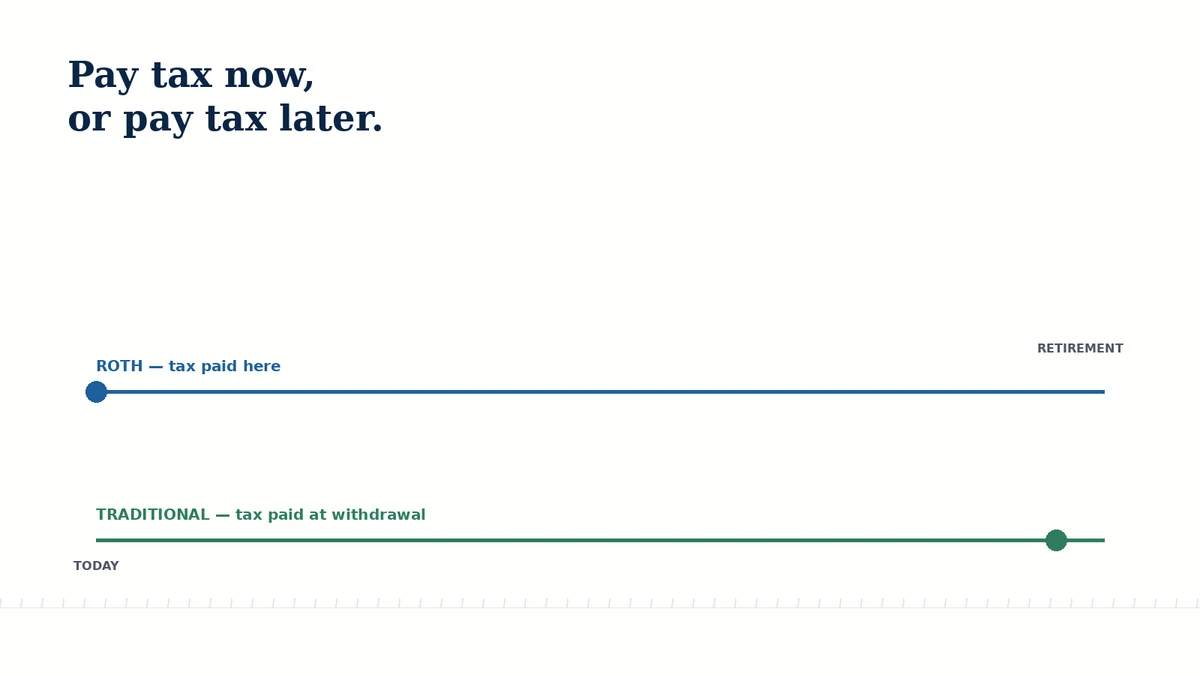
The Traditional vs. Roth decision is fundamentally about when you pay tax — now, or in retirement — not about which account "performs better," since the underlying index funds you can hold are typically identical between the two. Understanding this framing clarifies what's actually being decided, and why the honest answer for many people is "it depends on a comparison you can't know with certainty in advance."
The core mechanical difference
| Traditional IRA | Roth IRA | |
|---|---|---|
| Contribution | Pre-tax (often tax-deductible now, subject to income and other-plan-coverage limits) | After-tax (no deduction now) |
| Growth | Tax-deferred (no annual tax on dividends/gains) | Tax-free (no annual tax on dividends/gains) |
| Withdrawals in retirement | Taxed as ordinary income | Tax-free if qualified |
| Required Minimum Distributions | Generally required starting at a specified age | Generally not required for the original account owner |
Both account types shelter investment growth from annual taxation while the money is invested — the real difference is entirely about whether that tax is paid before contributing (Roth) or after withdrawing (Traditional).
A worked example illustrating the core tradeoff
Say you have $7,000 of pre-tax income to allocate, and your current marginal tax rate is 22%. With a Traditional IRA, the full $7,000 goes in pre-tax; assuming it grows at 7% annually for 30 years, it becomes roughly $53,000 — but then it's taxed on withdrawal. If your retirement marginal tax rate is also 22%, you'd keep roughly $41,340 after tax. With a Roth IRA, you'd first pay 22% tax on the $7,000, leaving $5,460 to actually contribute; growing at the same 7% for 30 years, that becomes roughly $41,570 — untaxed on withdrawal. In this scenario, where the tax rate is identical at contribution and withdrawal, the two approaches produce a very similar after-tax result (small differences here are simplification/rounding artifacts) — which is the key mathematical insight: if your tax rate is the same at both points, Traditional and Roth are roughly equivalent. The decision only meaningfully favors one over the other to the extent your tax rate actually differs between now and retirement. You can run your own numbers with our Roth vs. Traditional calculator.
When Roth tends to be favored
Roth contributions tend to be more favorable when you expect your tax rate in retirement to be higher than your current rate — commonly the case for younger investors early in their careers, currently in a relatively low tax bracket, who expect higher earnings (and potentially a higher tax bracket) later in life, or for anyone who simply expects overall tax rates to rise over time for reasons unrelated to their personal income. It's also favored by investors who value the flexibility of tax-free withdrawals and no required minimum distributions in retirement, and by those who want to leave tax-free assets to heirs.
When Traditional tends to be favored
Traditional contributions tend to be more favorable when you expect your tax rate in retirement to be lower than your current rate — commonly the case for higher earners currently in a high tax bracket who expect meaningfully lower income (and a lower bracket) in retirement. The upfront tax deduction can also free up more cash to actually invest today for someone contributing at their maximum comfortable savings capacity, since the pre-tax contribution costs less out-of-pocket than the equivalent after-tax Roth contribution.
Why many investors reasonably use both
Since future tax rates and personal circumstances decades from now aren't knowable with certainty, splitting contributions between Traditional and Roth accounts is a reasonable way to hedge against being wrong about the prediction in either direction — sometimes called "tax diversification." This also provides useful flexibility in retirement itself: having both taxable and tax-free withdrawal sources available allows for more flexible tax planning year to year in retirement than relying entirely on one account type. Investors who have access to one sometimes add a third tax-advantaged option into this mix — see HSA as a Retirement Investment Account for how a health savings account fits alongside a Traditional or Roth IRA.
Index fund selection is identical either way
It's worth emphasizing that the index fund selection process itself doesn't change based on this decision — the same broad, low-cost index funds discussed throughout this site work identically well inside either a Traditional or Roth IRA. The account-type decision is purely about tax timing; it has no bearing on which specific funds make sense for your goals and risk tolerance, covered in Building a 3-Fund Portfolio and Asset Allocation by Age. For a closer look specifically at the Roth side of this decision, see Index Funds in a Roth IRA.
Common mistakes
- Assuming one account type is universally better. The correct choice depends on a comparison of your current vs. future tax rate, which is genuinely uncertain.
- Ignoring the Traditional IRA's potential deductibility limits. If you (or a spouse) are covered by a workplace retirement plan, your Traditional IRA contribution's tax-deductibility may be limited based on income — check current IRS rules.
- Not considering Required Minimum Distributions. Traditional accounts generally require withdrawals starting at a specified age, which can affect retirement tax planning even if you don't need the money yet.
- Treating the decision as permanent and unchangeable. You can adjust your contribution split between account types in future years as your circumstances and tax situation change.
Frequently Asked Questions
Can I contribute to both a Traditional and Roth IRA in the same year?
Yes, but your combined contributions across both are subject to a single combined annual IRA limit set by the IRS — verify the current limit at IRS.gov.
Is a Traditional IRA contribution always tax-deductible?
Not always — deductibility can be limited or phased out based on income if you or a spouse are covered by a workplace retirement plan. Check current IRS rules for your specific situation.
Can I convert a Traditional IRA to a Roth IRA later?
Yes, this is possible via a Roth conversion, which is a taxable event on the converted amount — consider consulting a tax professional to understand the tax impact before converting.
Which is better for a beginner?
There's no universal answer — it depends on your current and expected future tax bracket. Many beginners early in their careers, in relatively low tax brackets, lean toward Roth, but this isn't personalized advice; consider your specific situation.
Summary
A Traditional IRA is funded pre-tax (often tax-deductible now) and taxed on withdrawal in retirement; a Roth IRA is funded after-tax now and grows completely tax-free, including qualified withdrawals in retirement. The deciding factor is whether your tax rate now is higher or lower than your expected tax rate in retirement — if lower now, Roth tends to be favored; if higher now, Traditional tends to be favored. Since future tax rates aren't knowable with certainty, many investors reasonably choose to diversify between both account types rather than betting entirely on one prediction.
This article is educational only and not personalized investment advice. See our full disclaimer.
Sources & References
Corrections & updates: No corrections logged since publication.