
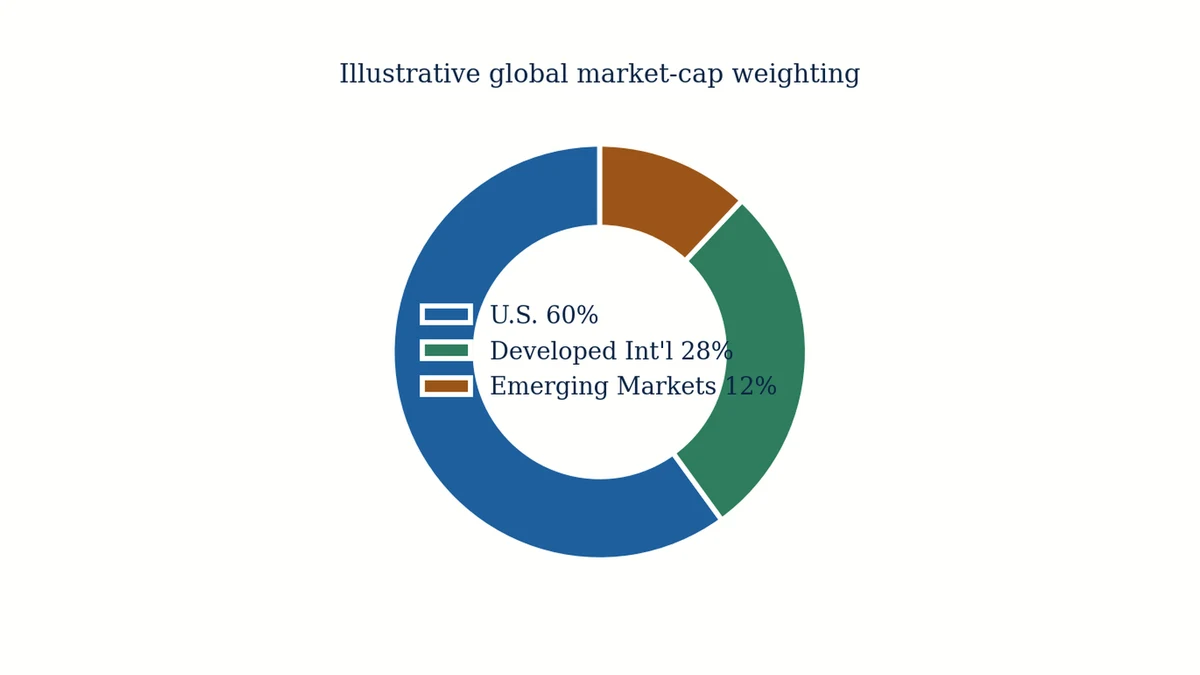
A total U.S. stock market fund gives you ownership in thousands of American companies — but zero direct exposure to Toyota, Nestlé, Samsung, or any other company headquartered outside the United States. An international index fund fills that specific gap. Whether it should be part of your portfolio, and how large a part, is a genuine, reasonable disagreement among long-term investors — not a settled question with one correct answer.
What an international index fund actually holds
An international index fund tracks a benchmark composed of companies headquartered outside the investor's home country — for a U.S. investor, that means everything from large, familiar multinational companies to smaller firms with no U.S. listing at all. Most broad international index funds split into two categories, sometimes combined into one fund and sometimes offered separately:
- Developed markets — economically established countries such as Japan, the United Kingdom, Germany, France, Canada, and Australia. These markets tend to have more mature regulatory environments and more stable currencies, broadly similar in character to the U.S. market.
- Emerging markets — countries with growing but less mature economies and capital markets, such as China, India, Taiwan, and Brazil. These markets have historically shown higher volatility and different risk characteristics than developed markets, including greater currency and political risk.
A "total international" index fund typically combines both categories into a single holding, weighted by market capitalization the same way a U.S. total market fund is — larger companies and larger country markets make up a proportionally bigger share of the fund.
The case for holding international index funds
The core diversification argument is straightforward: the U.S. economy and U.S. companies don't move in perfect lockstep with the rest of the world. A U.S.-only portfolio concentrates its outcome entirely in one country's regulatory environment, currency, and economic cycle. Holding international funds spreads that concentration across many countries and currencies, which — in periods when U.S. markets underperform relative to the rest of the world — can reduce a portfolio's overall volatility, though it can also reduce returns in periods when the U.S. outperforms, which has been a common pattern over much of the past decade. Neither pattern is guaranteed to continue, which is the central reason the diversification argument doesn't depend on predicting which region will do better next.
The case for skipping or limiting international exposure
The main counterargument, often called "home bias" when raised as a critique but treated by some investors as a deliberate, defensible choice, rests on a few points: U.S. companies already derive a substantial share of their revenue from international operations, providing some indirect global exposure even in a U.S.-only fund; the U.S. stock market has represented a large and, over recent years, growing share of total global market capitalization, meaning a U.S.-only investor isn't missing as much of the "world" as the country count alone might suggest; and international investing adds currency risk and, for emerging markets specifically, added political and regulatory risk that some investors prefer to avoid. Both the "hold international" and "U.S.-only" positions have been defended by credible, evidence-informed investors — this is a genuine area of reasonable disagreement, not a case where one side is simply uninformed.
How much international exposure is commonly discussed
| Approach | Illustrative international share of stock allocation | Reasoning |
|---|---|---|
| U.S.-only | 0% | Simplicity, avoids currency/country-specific risk, relies on U.S. companies' global revenue exposure |
| Modest allocation | ~10–20% | Some diversification benefit without large currency/country concentration |
| Market-cap weighted global | ~35–40% | Matches international markets' approximate share of total global stock market value |
These are illustrative reference points reflecting different reasonable philosophies, not a formula — see Building a 3-Fund Portfolio for how international funds fit into one common overall framework, and Asset Allocation by Age for how allocation decisions generally connect to time horizon and risk tolerance.
Currency risk: what it actually means
When you hold an international index fund, your investment return depends on both the performance of the underlying foreign companies and the exchange rate between the U.S. dollar and the relevant foreign currencies. If the dollar strengthens against a foreign currency, the dollar value of your international holdings can decline even if the underlying companies performed well in their local currency, and vice versa. Most standard international index funds do not hedge this currency exposure — a small number of specialized "currency-hedged" fund share classes exist for investors who specifically want to remove this effect, typically at a somewhat higher expense ratio. For most long-term investors, unhedged currency exposure is treated as an acceptable, expected part of holding international assets rather than a risk to actively manage around.
A worked example: how currency movement affects returns
Say a European company's stock rises 10% in local currency (euros) over a year. If the euro also strengthens 5% against the U.S. dollar over that same period, a U.S. investor holding that stock (or a fund holding it) would see a total return closer to 15% in dollar terms — the stock gain plus the currency gain. If instead the euro weakened 5% against the dollar over the same period, the U.S. investor's dollar return would be closer to 5% — the stock gain partially offset by the currency loss — despite the underlying company performing identically in both scenarios. This is a simplified illustration of the mechanism, not a prediction of any actual currency movement, which cannot be forecast reliably. The point is structural: international returns, as experienced by a U.S. investor, are a combination of the underlying market's performance and currency movement, and the two can partially offset or reinforce each other in either direction.
How international funds fit with U.S. funds you may already hold
International index funds are designed to complement, not duplicate, a U.S. stock fund — a total international index fund specifically excludes U.S. companies, so pairing it with a total U.S. market fund (rather than, say, two different U.S.-focused funds) avoids the overlap issue covered in Common Index Fund Investing Mistakes. This non-overlapping design is part of why "U.S. total market fund plus international total market fund" is such a common two-fund equity combination — each fund covers genuinely distinct territory, so the combination's overall diversification is additive rather than redundant. Some investors also hold a separate emerging-markets fund on top of a developed-markets fund for a modest emerging-market tilt beyond the market-cap-weighted default; this is a more granular, optional decision layered on top of the basic developed/emerging split, not a requirement.
Common mistakes
- Assuming a U.S. total market fund already includes international companies. It doesn't — total U.S. market funds hold only U.S.-headquartered companies, regardless of where those companies do business.
- Overweighting emerging markets based on recent strong performance. Emerging market returns have historically been more volatile and less predictable than developed markets; chasing a recent strong period is the same mistake covered generally in Common Index Fund Investing Mistakes.
- Treating the international allocation decision as permanently settled. It's reasonable to hold a considered view, but it's worth revisiting occasionally as your own understanding and the evidence evolve, rather than never reconsidering it.
- Ignoring expense ratio differences between international fund options. International index funds have historically carried a somewhat wider expense ratio range than U.S. funds — compare directly, per Expense Ratios Explained.
Frequently Asked Questions
Do I need international funds if I already own individual foreign stocks?
Not necessarily the same way — a small number of individual foreign holdings doesn't provide the same broad diversification as a fund holding thousands of international companies across many countries.
Are emerging market funds riskier than developed market funds?
Historically, emerging market funds have shown higher volatility and additional risks including currency and political risk, compared to developed market funds — though both carry more risk than holding no international exposure at all is sometimes assumed to avoid.
Should international funds go in a taxable or retirement account?
International funds often qualify for a U.S. foreign tax credit on foreign taxes withheld, which is more directly usable in a taxable account than inside a retirement account — see a tax professional for guidance specific to your situation, and our general discussion in Tax-Efficient Index Fund Investing.
What's a reasonable single fund for international exposure?
A total international stock index fund, combining developed and emerging markets in one holding, is a commonly used single-fund option — compare its current expense ratio and scope directly before choosing a specific fund.
Summary
International index funds hold companies outside the United States, split broadly into developed markets (Japan, the UK, much of Europe) and emerging markets (China, India, Brazil, and others), and are available as a combined "total international" fund or as separate developed/emerging funds. The case for holding them rests on diversification beyond a single country's economic cycle and currency; the case against rests on U.S. companies' historically dominant share of global market value and the added complexity of currency and country-specific risk. Commonly cited allocations range from 0% to roughly 40% of an equity portfolio — a wide range reflecting genuine, ongoing disagreement rather than a single correct answer.
This article is educational only and not personalized investment advice. See our full disclaimer.
Sources & References
Corrections & updates: No corrections logged since publication.