
If you've ever enrolled in a 401(k) and been defaulted into a fund with a year in its name — something like "2055 Retirement Fund" — you were handed a target-date fund without necessarily choosing one. It's one of the most widely held fund types in American retirement accounts, and also one of the least explained: most participants know roughly what it's for, but not how it actually works underneath, or when it's genuinely the right tool versus a convenient default.
How a target-date fund actually works
A target-date fund is built around a single assumption: an investor's appropriate mix of stocks and bonds should become more conservative as they approach a specific future date, typically retirement. The fund's name encodes that date — a "Target 2055 Fund" is built for someone expecting to retire around 2055. Internally, the fund holds a diversified basket of underlying stock and bond funds (often index funds, though not always), and the provider adjusts the proportions on a predetermined schedule as the target year gets closer, without requiring the investor to do anything.
This means a target-date fund is really a fund of funds: your money isn't invested directly in individual stocks or bonds, but in a managed blend of other funds, weighted according to the target-date fund's own allocation formula. That formula, and how it changes over time, is called the glide path.
What a "glide path" actually means
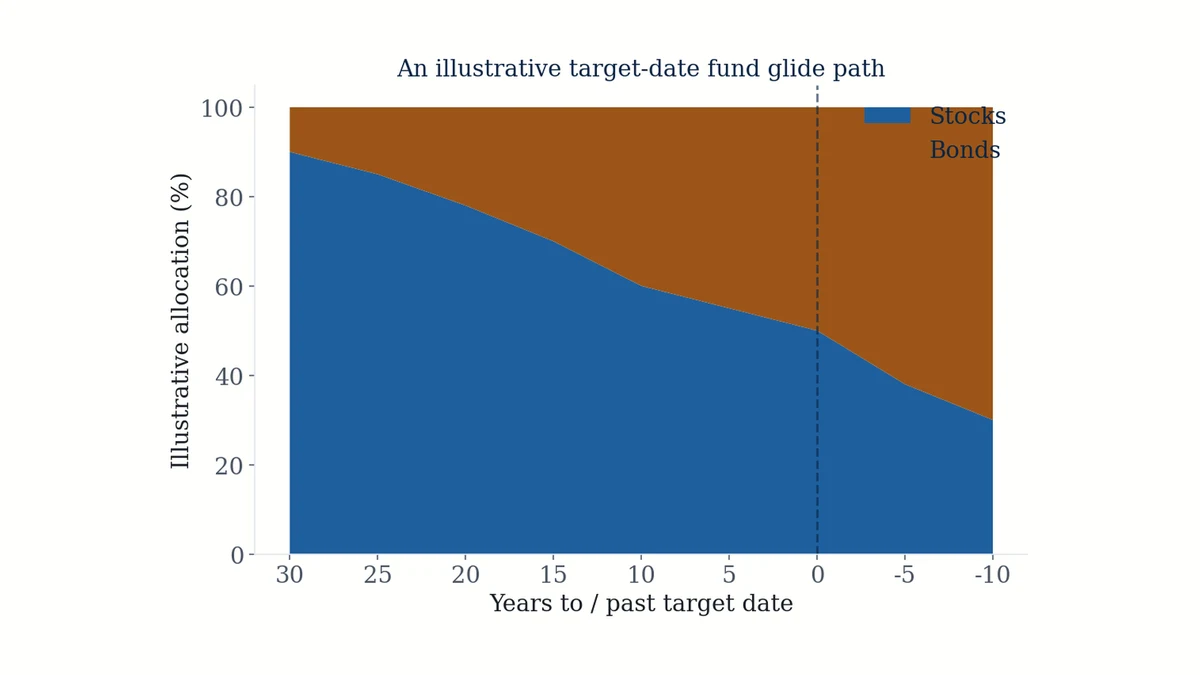
The glide path is the predetermined trajectory a target-date fund follows — typically starting with a high stock allocation (often 85–95%) for a fund with a distant target date, and gradually shifting toward more bonds as that date approaches. Some providers continue adjusting the allocation for years after the target date itself ("to" funds stop adjusting at the target date; "through" funds continue adjusting into retirement), which is a genuine structural difference worth checking in a specific fund's prospectus rather than assuming.
| Years to target date | Illustrative stock allocation | Illustrative bond allocation |
|---|---|---|
| 30 years out | ~90% | ~10% |
| 15 years out | ~70% | ~30% |
| At target date | ~50% | ~50% |
| 10 years past target | ~30% | ~70% |
Two funds with the identical target year from different providers can have meaningfully different glide paths — one might hold more stock at retirement than another, reflecting a different assumption about how long the money needs to keep growing during retirement itself. This is the detail most participants never check, despite it being one of the more consequential differences between otherwise similar-sounding funds.
What you're actually paying for
A target-date fund's expense ratio typically runs somewhat higher than the underlying index funds it holds, because you're paying for the ongoing allocation management and rebalancing on top of the funds themselves. This is a real, quantifiable cost — covered in general terms in Expense Ratios Explained — and it's worth comparing a specific target-date fund's expense ratio against the cost of assembling a similar mix yourself using the underlying index funds directly, which is typically cheaper but requires you to do the rebalancing work the target-date fund would otherwise handle.
The size of that gap varies significantly by provider. Some large low-cost providers price their target-date funds only modestly above their underlying index funds; others, particularly older or actively managed target-date series, can carry a meaningfully larger premium. Checking the specific fund's current expense ratio directly — not assuming based on the provider's general reputation — is the only reliable way to know.
Target-date fund vs. building it yourself
This is fundamentally the same tradeoff covered in Robo-Advisors vs. DIY Index Investing, applied to a different product: a target-date fund automates allocation and rebalancing for a fee; a manually assembled portfolio — such as the approach in Building a 3-Fund Portfolio — avoids that fee but requires you to actually do the rebalancing and allocation-adjustment yourself, on schedule, including during years when it doesn't feel like an easy decision. For a direct, numbers-based look at exactly this comparison, including what the fee gap actually adds up to over time, see 3-Fund Portfolio vs. Target-Date Fund.
- You don't want to manage allocation or rebalancing yourself
- You want a single fund covering an entire retirement account
- You're comfortable accepting a provider's generic glide path assumptions
- You want a lower overall cost and are willing to rebalance yourself
- Your risk tolerance or timeline differs from a generic glide path
- You're combining several accounts and want one consistent, chosen allocation across all of them
Common misconceptions
- "The target year is when I should retire." The year is a planning anchor for the glide path, not a personalized recommendation — your actual retirement timing depends on your full financial picture, not a fund name.
- "All target-date funds with the same year are the same." As shown above, glide paths and expense ratios vary by provider — two "2055" funds can hold meaningfully different allocations at any given point.
- "A target-date fund guarantees an appropriate risk level for me." It reflects an assumption about a typical investor at that timeline, not your specific risk tolerance, other savings, or expected retirement expenses — see Asset Allocation by Age for the broader reasoning behind why age-based defaults are a starting point, not a personalized answer.
- "I should hold a target-date fund alongside other funds for diversification." A target-date fund is already a complete, diversified portfolio on its own — pairing it with other stock or bond funds usually just skews the overall allocation away from the glide path's intended mix, a version of the fund-overlap issue covered in Common Index Fund Investing Mistakes.
How to evaluate a specific target-date fund
If your 401(k) defaults you into a target-date fund, or you're considering one directly, a few checks are worth doing before assuming it's the right fit: read the fund's glide path illustration in its prospectus (most providers publish this as a simple chart); confirm whether it's a "to" or "through" fund, since that changes the allocation at and after your target date; compare its expense ratio against your plan's other available index fund options; and sanity-check the target year itself against your actual expected retirement timeline rather than defaulting to whatever year the fund was auto-assigned based on your birth year.
Frequently Asked Questions
Can I choose a different target-date fund than the one matching my birth year?
Yes — the target year is a planning convenience, not a rule. Some investors deliberately choose a later target date than their expected retirement year if they want a more aggressive allocation, or an earlier one for a more conservative mix.
Do target-date funds only hold index funds?
Not always. Some providers build target-date funds primarily from index funds; others include actively managed underlying funds. Check the specific fund's holdings in its prospectus rather than assuming.
Is a target-date fund a good sole holding for a retirement account?
For many investors who want a single, automatically managed fund, yes — that's specifically what it's designed for. Whether it's the right choice depends on your comfort with its glide path and fees compared to the alternative of managing your own allocation, covered above.
What happens to a target-date fund after the target year passes?
Depends on the provider: "to" funds generally stop adjusting their allocation at the target date, while "through" funds continue shifting more conservative for years afterward. Check your specific fund's prospectus to know which type it is.
Summary
A target-date fund holds a mix of stocks, bonds, and sometimes other assets that automatically shifts toward a more conservative allocation as its target year approaches, following a predetermined "glide path." It bundles diversification, allocation, and rebalancing into a single fund, at a somewhat higher cost than assembling the same pieces yourself. For an investor who doesn't want to manage allocation manually, a well-chosen target-date fund is a reasonable, evidence-informed default — but "well-chosen" matters, since glide paths and fees vary meaningfully between providers, and the target year alone doesn't guarantee a fund matches your actual risk tolerance.
This article is educational only and not personalized investment advice. See our full disclaimer.
Sources & References
- SEC — Investor.gov: Target-Date Funds
- U.S. Department of Labor — Target-Date Retirement Funds — Tips for ERISA Plan Fiduciaries
- FINRA — Target-Date Funds
Corrections & updates: No corrections logged since publication.