
The S&P 500 is probably the single most referenced number in American financial media, and it's also one of the most commonly misunderstood. It's not simply "the 500 biggest U.S. companies," and an S&P 500 index fund is not automatically "the whole stock market," even though both phrases get used loosely. Understanding what the index actually includes — and excludes — matters for knowing what you own.
What the S&P 500 actually is
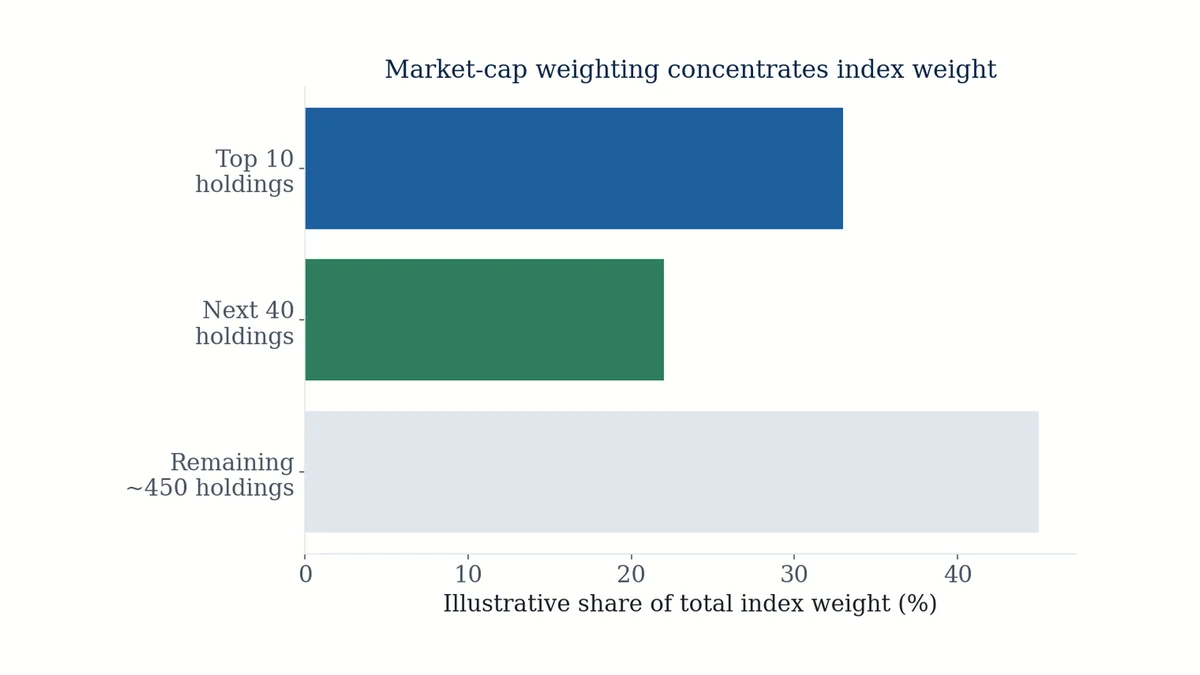
The S&P 500 is maintained by S&P Dow Jones Indices, and inclusion is determined by a committee applying published eligibility criteria — including minimum market capitalization, sufficient trading liquidity, and a requirement to be a U.S. company with positive earnings over specified recent periods. This means the index isn't a simple mechanical ranking of the 500 largest companies; profitable, liquid large companies can be excluded, and the committee has some discretion within its published rules. The index is market-capitalization weighted, meaning a company's size in the market — not an equal 1/500th share — determines how much it influences the index's overall performance. In practice, this means the largest handful of companies in the index can represent a disproportionately large share of its total weight and returns.
What an S&P 500 index fund does and doesn't give you
| Included | Not included |
|---|---|
| Roughly 500 large, established U.S. companies | Small-cap and mid-cap U.S. companies |
| Companies across most major U.S. sectors | International (non-U.S.) companies |
| Both "growth" and "value" style companies broadly | Bonds or any fixed-income exposure |
This is why an S&P 500 index fund, while broadly diversified within large-cap U.S. stocks, is not a complete portfolio on its own for many investors — it has zero exposure to smaller U.S. companies, international markets, or bonds. Some investors deliberately choose an S&P 500 fund as their sole equity holding and accept that scope; others pair it with international and small-cap funds for broader exposure. Both are reasonable, considered choices — the mistake is not realizing which one you're making. What it does give you includes the dividends paid by its underlying companies, which most brokerages let you automatically reinvest — see Dividend Reinvestment (DRIP) for how that works and why it matters for long-term growth.
Concentration: the part that surprises people
Because the index is weighted by market capitalization, and a small number of very large technology and growth companies have grown to represent a substantial share of total U.S. market value in recent years, the S&P 500's top 10 holdings can represent a notably large share of the index's total weight and return — sometimes over a quarter, depending on market conditions at any given time. This means an S&P 500 index fund's near-term performance can be meaningfully influenced by how a relatively small number of large companies perform, even though the fund technically holds 500 different companies. This isn't a flaw in the index — it's an accurate reflection of how market value is actually distributed among U.S. public companies — but it's a nuance worth understanding rather than assuming "500 companies" automatically means the risk is spread evenly.
S&P 500 vs. total U.S. stock market index funds
A common alternative to an S&P 500 fund is a total U.S. stock market index fund, which includes small and mid-cap companies in addition to large-caps — often several thousand companies rather than roughly 500. In practice, because of market-cap weighting, the S&P 500 and a total market fund tend to perform very similarly over time, since large-cap companies dominate the weighting of both — but they're not identical, and a total market fund provides modestly broader diversification by including smaller companies the S&P 500 excludes entirely. Neither choice is clearly superior; they represent a small difference in scope more than a fundamentally different strategy.
How the index is rebalanced
S&P Dow Jones Indices periodically reviews and adjusts the index's membership — removing companies that no longer meet eligibility criteria (due to acquisition, decline, or other factors) and adding new eligible companies. Index funds tracking the S&P 500 adjust their holdings to match these changes, a process that's largely automatic and doesn't require any action from individual fund shareholders. This periodic reconstitution is part of why the index has historically avoided becoming permanently weighted toward companies that decline significantly, without requiring active stock-picking judgment — it's a rules-based process, not a discretionary one, even though a human committee applies the rules.
Common mistakes
- Treating "S&P 500 fund" as synonymous with "diversified portfolio." It's diversified within large-cap U.S. stocks specifically, not across all asset classes or geographies.
- Assuming equal weighting. The index is market-cap weighted, so it's more concentrated in its largest constituents than an equally-weighted list of 500 companies would be.
- Comparing S&P 500 funds only on expense ratio without confirming they're actually the same index. Nearly all mainstream S&P 500 funds do track the same index, but always confirm before assuming — see VOO vs. VTI vs. SPY for a direct example of how this plays out between three specific funds.
- Ignoring international diversification entirely. Some investors deliberately choose U.S.-only exposure; others add international funds — see Building a 3-Fund Portfolio for one common framework.
Frequently Asked Questions
Is the S&P 500 the same as 'the stock market'?
It's a widely used proxy for the U.S. large-cap stock market and is often used informally to describe 'the market,' but it excludes small and mid-cap U.S. companies and all international markets — it's a segment of the broader market, not the entire market.
How many companies are actually in the S&P 500?
Approximately 500, though the exact count and membership changes periodically as the index committee adds and removes companies against its eligibility criteria.
Do all S&P 500 index funds perform identically?
They aim to, since they track the same underlying index, but small differences in expense ratio and tracking accuracy can cause minor differences in actual realized returns between funds from different providers.
Is an S&P 500 fund enough for retirement on its own?
It can be a reasonable single holding for some investors, but it excludes small-cap, international, and bond exposure entirely — whether that matters depends on your individual goals and risk tolerance. This isn't personalized advice; consider your specific situation or consult a financial professional.
Summary
The S&P 500 is a market-capitalization-weighted index of roughly 500 large, profitable U.S. companies selected by a committee against defined eligibility criteria, not simply a raw list of the 500 largest companies. An S&P 500 index fund gives you exposure to large-cap U.S. stocks specifically — it excludes small and mid-cap companies and all international markets, which matters when you're deciding whether it should be your only holding or one piece of a broader portfolio.
This article is educational only and not personalized investment advice. See our full disclaimer.
Sources & References
Corrections & updates: No corrections logged since publication.