
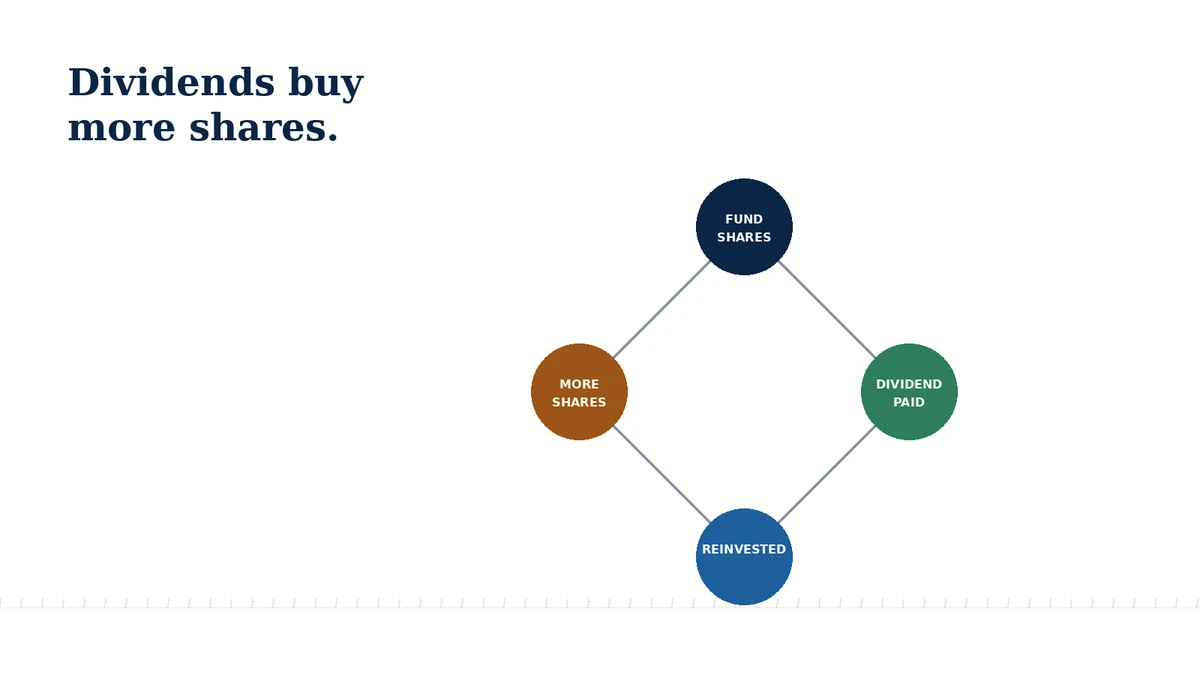
When a fund pays a dividend, you have two options: take the payment as cash, or automatically use it to buy more shares of the same fund — a process called dividend reinvestment, often abbreviated DRIP. For a long-term investor not currently relying on the income, reinvesting is usually the default choice, and the compounding effect of doing so consistently over decades is larger than it might initially seem.
How DRIP works mechanically
When you enable dividend reinvestment on a fund, any dividend payment is automatically used to purchase additional shares (or fractional shares) of that same fund on or near the payment date, instead of being deposited as cash into your account. Most major brokerages offer this as a simple account-level or fund-level setting, at no additional cost, and it can typically be turned on or off at any time.
Why reinvesting compounds meaningfully over time
Dividends that are reinvested go on to earn their own returns (including their own future dividends), the same way any other invested dollar does — the same underlying force covered in Expense Ratios Explained, just working in your favor here instead of against you. Skipping reinvestment doesn't just forgo that specific dividend payment's future growth — it forgoes the growth of every subsequent dividend that additional share would have generated, compounding the gap over time. For a broad U.S. stock index fund, a meaningful share of the fund's total historical return has come specifically from reinvested dividends rather than price appreciation alone, which is part of why "total return" (price change plus dividends) rather than price change alone is the more complete way to evaluate a fund's actual performance over time.
A worked example
Consider two otherwise identical $20,000 investments in the same fund over 25 years, assuming a 7% average annual price return and an additional 2% average annual dividend yield. Investor A reinvests all dividends; Investor B takes dividends as cash and spends them, leaving only the price return compounding. Investor A's approximate effective annual total return is closer to 9%, compounding to roughly $172,000 after 25 years. Investor B's investment grows at closer to the 7% price-return rate alone, compounding to roughly $109,000 — a gap of roughly $63,000, from the exact same starting investment and the exact same fund, purely from the reinvestment decision. This example uses simplified, illustrative assumptions; actual dividend yields and returns vary by fund and over time.
When taking dividends as cash makes sense instead
Reinvesting isn't universally the right choice — it depends on whether you currently need the income. An investor in retirement relying on dividend income to help cover living expenses may reasonably choose to take dividends as cash rather than reinvest them, since the money is serving its intended purpose as income rather than being available for further long-term growth. This is a matter of matching the choice to your actual current need for the money, not a universal rule that reinvesting is always correct.
Fractional shares and how DRIP handles leftover cash
A practical mechanical question: what happens when a dividend payment isn't large enough to buy a whole share? Most brokerages handle this by purchasing a fractional share — for example, a $23 dividend on a $187 share price buys roughly 0.123 of a share, credited to your account the same way a whole share would be. This is why DRIP portfolios often show oddly precise share counts (14.387 shares, for instance) rather than round numbers. Not every brokerage supports fractional-share reinvestment for every fund, so if you notice dividend cash sitting uninvested in your account rather than being reinvested, it's worth checking your specific provider's DRIP settings and fractional-share support directly rather than assuming reinvestment is happening automatically.
A simple way to decide which setting fits your account
As a practical rule of thumb: for money you won't touch for years — a retirement account, or a taxable account earmarked for a long-term goal — reinvesting is the more common default, since it removes a manual step and keeps the full dividend working for you immediately. For an account you're actively drawing income from, such as in retirement, taking dividends as cash and directing them to spending needs is the more natural fit, and there's no need to manually sell shares to generate that income. Some investors also turn off reinvestment temporarily during rebalancing, so that new dividend cash can be directed toward whichever asset class is currently underweighted rather than automatically buying more of the fund that paid it — a technique covered in Rebalancing Your Portfolio.
Tax treatment of dividends, reinvested or not
In a taxable brokerage account, dividends are generally taxable income in the year they're paid, whether you take them as cash or reinvest them automatically — reinvesting doesn't defer or avoid the tax owed on the dividend itself, since the IRS treats it as income received either way. In a tax-advantaged account like a 401(k), Traditional IRA, or Roth IRA, dividends aren't taxed as they're received, regardless of whether they're reinvested, which removes this specific consideration from the reinvestment decision inside those account types — see Index Funds in a Roth IRA for more on how that account specifically works. Qualified dividends in a taxable account are generally taxed at long-term capital gains rates rather than ordinary income rates, provided certain holding-period requirements are met — see IRS guidance for specifics, and consider consulting a tax professional for your situation.
Common mistakes
- Assuming reinvestment avoids taxes in a taxable account. It doesn't — the dividend is still taxable income in the year received, reinvested or not.
- Leaving dividends sitting as uninvested cash by accident. If reinvestment isn't enabled, dividend cash can sit uninvested, earning little to nothing, without the investor necessarily noticing.
- Not checking whether reinvestment is enabled after opening a new account. Default settings vary by brokerage — confirm your preference is actually set as intended.
- Underestimating dividends' share of total long-term return. Focusing only on a fund's price chart, without accounting for reinvested dividends, understates the fund's actual historical total return.
Frequently Asked Questions
Does DRIP cost extra?
Most major brokerages offer automatic dividend reinvestment at no additional cost, including support for purchasing fractional shares so the entire dividend amount is put to use.
Do I owe taxes on reinvested dividends in a Roth IRA?
No — dividends within a Roth IRA aren't taxed as they're received, and qualified withdrawals in retirement are generally tax-free, regardless of the reinvestment decision.
Can I reinvest dividends into a different fund than the one that paid them?
Standard DRIP typically reinvests into the same fund that paid the dividend; investing dividend cash into a different fund would generally require manually directing that cash, either by disabling automatic reinvestment or investing the cash separately.
Do all funds pay dividends?
No — funds vary based on their underlying holdings. A broad U.S. stock index fund typically pays dividends from the dividend-paying companies it holds; a fund holding only non-dividend-paying growth companies would pay little or no dividend income.
Summary
Dividend reinvestment automatically uses dividend payments to purchase additional shares of the same fund rather than paying them out as cash, which meaningfully increases long-term compounding for an investor not currently relying on that income. Most major brokerages offer this as a free, automatic setting. In a taxable account, dividends are generally taxable in the year received whether or not they're reinvested, which is a separate consideration from the reinvestment decision itself.
This article is educational only and not personalized investment advice. See our full disclaimer.
Sources & References
Corrections & updates: No corrections logged since publication.