
Stocks get most of the attention in personal finance content, but a bond index fund is doing a specific, different job in a portfolio — not maximizing growth, but reducing how much the portfolio swings when stocks decline. Understanding what a bond fund actually holds, and why its price moves the way it does, matters more than it might seem once you're deciding how much of your portfolio should be in bonds at all.
What a bond actually is, briefly
A bond is essentially a loan: when you buy a bond, you're lending money to whoever issued it — a government (Treasury bonds), a corporation (corporate bonds), or a municipality (municipal bonds) — in exchange for periodic interest payments and the return of your principal at a set maturity date. A bond fund holds many individual bonds at once, giving you diversified exposure to that income stream and its associated risks without needing to buy and manage individual bonds yourself.
Why bond prices move — the interest rate mechanism
This is the part that confuses many new investors: bond fund values can decline even though bonds are often described as "safer" than stocks. The mechanism is straightforward once you see it. Say you hold a bond paying 3% annual interest. If newly issued bonds start paying 5% (because overall interest rates rose), your existing 3% bond becomes less attractive by comparison — nobody would pay full price for it when they could buy a new bond paying more. Its market price falls to compensate, so that its effective yield to a new buyer becomes competitive with the new 5% bonds. The reverse happens when rates fall: existing higher-paying bonds become more valuable, and their price rises.
This is called interest rate risk, and it applies to bond funds just as it does to individual bonds — when interest rates rise broadly, a bond fund's share price typically falls, even though the fund's underlying bonds haven't defaulted or become individually riskier.
Duration: the number that tells you how sensitive a bond fund is
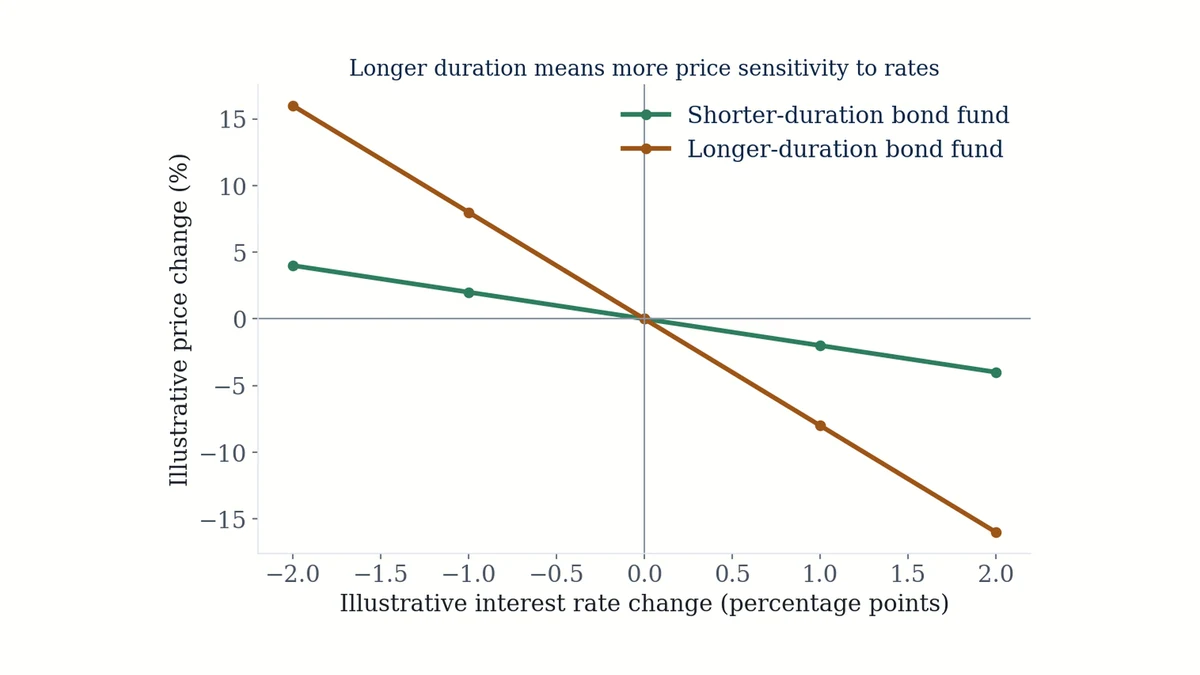
"Duration" is a bond fund metric — expressed in years — that approximates how much a fund's price will move for a given change in interest rates. As a rough rule of thumb, a fund with a duration of 5 years would be expected to lose approximately 5% of its value if interest rates rose by 1 percentage point (all else equal), and gain approximately 5% if rates fell by 1 percentage point. Longer-duration bond funds (holding bonds with longer maturities) are more sensitive to interest rate changes than shorter-duration funds; a fund holding mostly short-term bonds will generally show smaller price swings from rate changes than a fund holding mostly long-term bonds, though it typically also pays a lower yield in exchange for that stability. This tradeoff — more stability with a shorter duration, more yield potential (and more rate sensitivity) with a longer one — is the central decision in choosing a bond fund's maturity profile.
Common types of bond index funds
| Type | Holds | General risk profile |
|---|---|---|
| Total bond market fund | A broad mix of U.S. government and investment-grade corporate bonds | Moderate duration, low credit risk, commonly used as a core holding |
| Treasury bond fund | U.S. government bonds only | Considered to carry minimal credit risk (backed by the U.S. government), still subject to interest rate risk |
| Short-term bond fund | Bonds with shorter maturities | Lower interest rate risk, typically lower yield |
| Corporate bond fund | Bonds issued by companies | Adds credit risk (issuer default risk) on top of interest rate risk, typically higher yield |
| TIPS fund | Treasury Inflation-Protected Securities | Principal adjusts with inflation, offering some inflation protection specifically |
A "total bond market" index fund is the most commonly used single bond holding for a diversified portfolio, similar in role to a total stock market fund on the equity side — broad, low-cost exposure across many individual bonds rather than a concentrated bet on one type or maturity.
Why hold bonds at all if they can lose value too?
Bonds aren't included in a portfolio because they can't decline — they can, as shown above. They're included because they've historically shown meaningfully lower volatility than stocks, and their price movements haven't always moved in the same direction as stocks at the same time, which can reduce a portfolio's overall swings when the two are combined. This is the core logic behind the stock/bond allocation decisions covered in Asset Allocation by Age and implemented in Building a 3-Fund Portfolio — bonds are the lever most commonly used to dial a portfolio's overall risk level up or down, more so than trying to pick "safer" stocks.
Common mistakes
- Assuming a bond fund can't lose value. It can, primarily through interest rate risk, as explained above — "lower volatility than stocks" is not the same as "risk-free."
- Ignoring duration when comparing bond funds. Two bond funds with similar names can have very different interest-rate sensitivity depending on the maturities they hold.
- Holding bond funds in a taxable account when tax-advantaged space is available. Bond interest is generally taxed as ordinary income, which is often less tax-efficient in a taxable account — see Tax-Efficient Index Fund Investing.
- Holding zero bonds regardless of time horizon. This can be a reasonable deliberate choice for a very long horizon, but it's worth being a deliberate decision rather than an oversight — see Asset Allocation by Age.
Frequently Asked Questions
Are bond funds safer than individual bonds?
A bond fund diversifies away the risk of any single issuer defaulting, but it doesn't have a fixed maturity date the way an individual bond does, and it remains subject to interest rate risk in the same way.
Do bond funds pay dividends?
Bond funds typically distribute the interest income from their underlying bonds to shareholders, often monthly, generally referred to as dividend distributions even though the underlying income is bond interest.
Should I hold bonds if I'm young with a long time horizon?
Many younger investors with long horizons hold a small or zero bond allocation, reasoning they have time to ride out stock volatility — this is a defensible position, though it's a personal risk-tolerance decision, not a universal rule.
What happens to my bond fund if interest rates fall?
Existing bond prices generally rise when interest rates fall, since the fund's current bonds become relatively more attractive than newly issued lower-paying bonds — the inverse of the interest rate risk mechanism explained above.
Summary
A bond index fund holds a diversified basket of bonds — loans to governments or corporations — and its value moves inversely with interest rates: when rates rise, existing bond prices generally fall, and vice versa. Bonds have historically shown lower volatility than stocks and provide regular interest income, which is why they're commonly used to reduce a portfolio's overall swings, particularly as an investor's time horizon shortens. A bond fund is not risk-free — interest rate risk, and for some bond types, credit risk, both apply — but it plays a different role than a stock fund, not a lesser one.
This article is educational only and not personalized investment advice. See our full disclaimer.
Sources & References
- SEC — Investor.gov: Bonds
- FINRA — Interest Rate Risk
- TreasuryDirect.gov — Treasury Inflation-Protected Securities (TIPS)
Corrections & updates: No corrections logged since publication.